Paper wallets are not the most popular method to manage crypto assets. But for people who choose to use paper wallets, creating them correctly and encrypting them with a strong password makes them among the best safeguards against hackers. A paper wallet keeps private keys offline and out of reach of hackers.
There is also the option to encrypt it with a password or passphrase for extra security. Going that route will keep your private keys safe even if someone finds your paper wallet. But what happens if you lose this password/passphrase and access to your private keys? How can you decrypt your paper wallet and recover your assets?
To answer this, it’s best to understand how paper wallets work.
What Is a Paper Wallet?
Cryptocurrencies are a unique form of money. Being digital, Bitcoin (BTC), Dogecoin (DOGE), Ethereum (ETH), and other crypto assets exist online as data on the blockchain. Here, users rely on public-private key pairs to manage their tokens.
Every crypto token is linked to a public key, which is an address on the blockchain. At the same time, each public key has a corresponding private key. It acts as a digital signature and lets you spend any assets associated with your blockchain address.
Managing cryptocurrencies revolves around this key pair. If you want someone to send you crypto, you give them your blockchain address. If you want to send someone crypto, the private keys will be used to authorize the transaction.
Crypto wallets provide a way to generate, handle, and secure your public-private key pair(s). This can be an application like MetaMask, Trust Wallet, Binance, or Rabby Wallet, a device like Ledger or Trezor, or, in our case, a piece of paper.
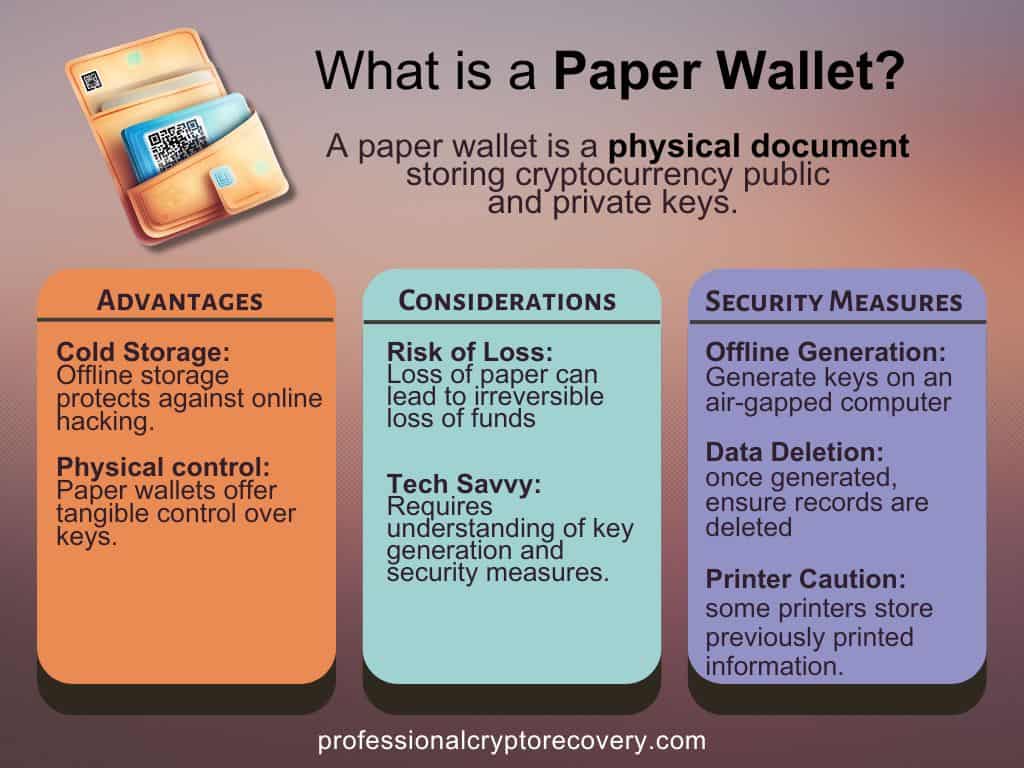
A paper wallet is just that: a piece of paper that stores your public and private keys.
Paper wallets don’t generate the keys. For that, you will need a platform like BitAddress, which generates Bitcoin keys and gives them to you as an alphanumeric string and QR code.
You can either print this or write it down on a piece of paper to make a paper wallet. Ideally, whatever platform you use shouldn’t store a record of your public-private key pair. The reason why is so that any record of it is yours and yours alone.
Conduct your research before trusting a platform to generate your paper wallet. For absolute security, you’ll want to do this on an air-gapped computer (not connected to the internet) from a bootable USB/flash drive. This ensures that your private keys don’t get exposed online, and no local records of them remain on the OS.
Note that some printers store previously printed information, and it can be reprinted. You need to be careful about your printer choice.
Encrypting a Paper Wallet
A piece of paper cannot connect to the internet and doesn’t contain any code that could be hacked. This makes paper wallets a very secure way to store your keys if you are concerned about hackers getting your assets. However, this doesn’t mean you’re entirely safe. There’s always the risk that someone will find your paper wallet and the keys it contains.
So, what do you do?
Many users decide to encrypt their private keys with a password before generating them. Such keys must be decrypted before they can be used. If someone finds the wallet and attempts to transact funds associated with your address, they will be unable to do so unless they have the password.
Encrypting your paper wallet enhances security. However, it also means that if you forget or lose part or all of your password, you’ll lose access to your keys until you can decrypt your wallet.
Decrypting Your Paper Wallet Without Its Password
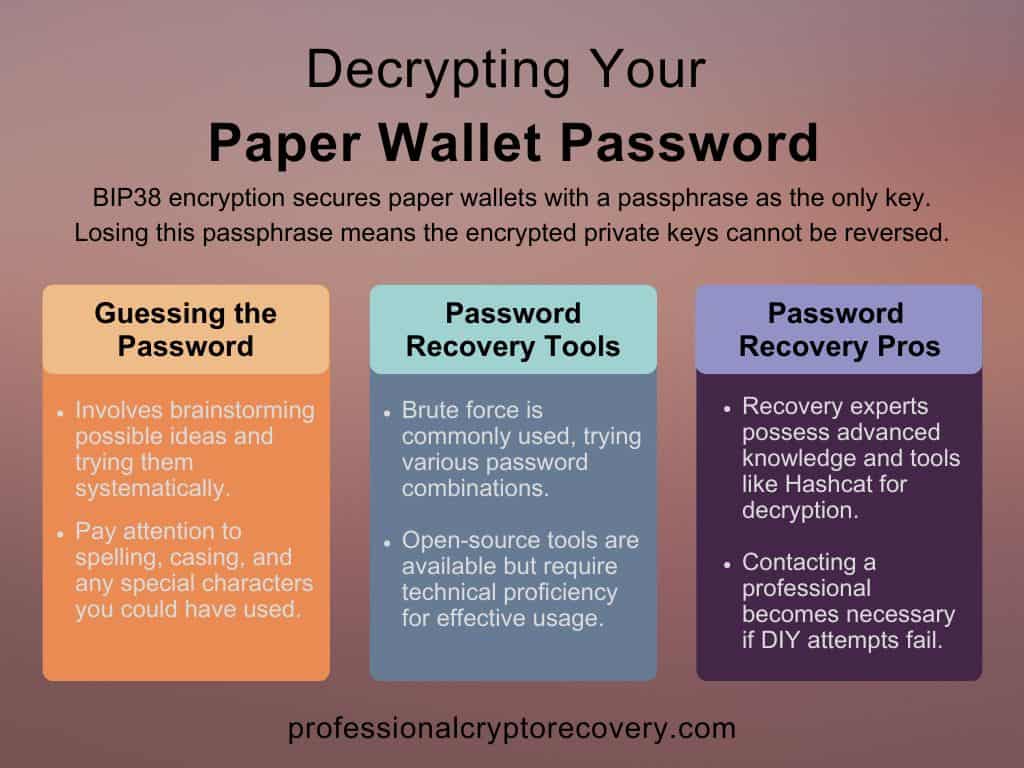
Paper wallets typically use BIP38 encryption. It’s designed to be a one-way process, with your passphrase as the only key that can unscramble the encrypted private keys. If you lose this passphrase, there is realistically no way to reverse the encryption to reveal the raw private key. The only hope of saving your wallet is to recover the password.
Recovering Paper Wallet Password
Forgetting a password is something we’ve all done. And while that problem can often be fixed by resetting the password, this option isn’t available in the world of non-custodial crypto holding. An affected user who hopes to recover their wallet will have to remember the original password, recover it, or hire a wallet recovery expert.
Try Guessing Your Lost Paper Wallet Password
If you have lost your paper wallet passphrase, your first option is to try to guess it. Brainstorm as many possible password ideas as possible and write them down. Think of what the passphrase could have been, like your birthday or graduation date.
Once you have this list, try each option, paying attention to the spelling, casing, and any special characters. This method is most likely to work if you have a rough idea of what your password could be. But if it doesn’t, you can move on to the next option.
Using Special Password Recovery Tools
Password recovery tools are software tools that leverage cryptographic techniques to crack passwords. These techniques include brute forcing, where the software tries as many password combinations as possible.
It doesn’t always work. However, if you have a decent idea of what your lost paper wallet passphrase could be, you can use it to narrow down the scope of the search. This gives you a better chance of recovering your wallet.
There are some good, open-source password recovery tools, including BTCRecover and Hashcat.
You need a decent amount of technical knowledge to wield these tools effectively, though. If you lack such skills, let someone with the expertise do it for you. That’s where crypto recovery professionals come in.
Password Recovery Professionals
Hiring a crypto recovery professional is where the best chance of recovering your assets lies. A recovery expert is well-versed in crypto password recovery techniques and can utilize a tool like Hashcat much better than you can. Therefore, if all your DIY recovery attempts have failed, it’s time to contact a professional.
That doesn’t necessarily mean that you won’t be involved in the process. The recovery procedure requires you to provide possible password ideas to help with the search. There might also be some back-and-forth as the expert works to figure out the best approach to recover your password and decrypt your paper wallet.
Contact a Wallet Recovery Professional Today
Losing your paper wallet password means losing access to your private keys and precious crypto assets. But with our help, that doesn’t have to be the case.
We have been in the IT industry for over 20 years and have successfully recovered many crypto wallets. Our services are fast, efficient, and more affordable than the average market rate.
Contact us now to recover your lost paper wallet password.
Frequently Asked Questions
We charge 18% of any successfully recovered wallet. There is no fee if we cannot recover your wallet. See our pricing page for more details.
No. We only accept payment after a successful wallet recovery.