Crypto wallets that connect to the internet are known as hot wallets. Designed with a focus on convenience and ease of use, they are the primary gateway to decentralized finance (DeFi), allowing users to mint, swap, and transact tokens on the blockchain.
Most crypto wallets today are hot wallets. But they’re not all equal. Depending on your objectives, some wallets will suit you better than others. So, what are the best hot wallets for cryptocurrency?
Let’s dive in.
Introduction to Hot Wallets
Crypto wallets fall into two broad categories, cold and hot, based on whether they connect to the internet. The former category includes hardware, paper, and audio wallets. These are crypto wallets that do not connect to the internet.
On the opposite end are hot wallets. Unlike cold storage, which typically involves an external physical device or platform, hot wallets are software applications running on your phone or computer. They typically need an internet connection to work.
Compared to cold wallets, this online feature slightly increases the vulnerability of hot wallets to remote attacks, but it also makes it easier to access and manage digital assets. So, hot wallets are preferred for daily transactions and trading.
Hot Wallet Categories
Hot wallets can be further categorized based on several criteria. Being familiar with these will help you choose the best wallet for your needs.
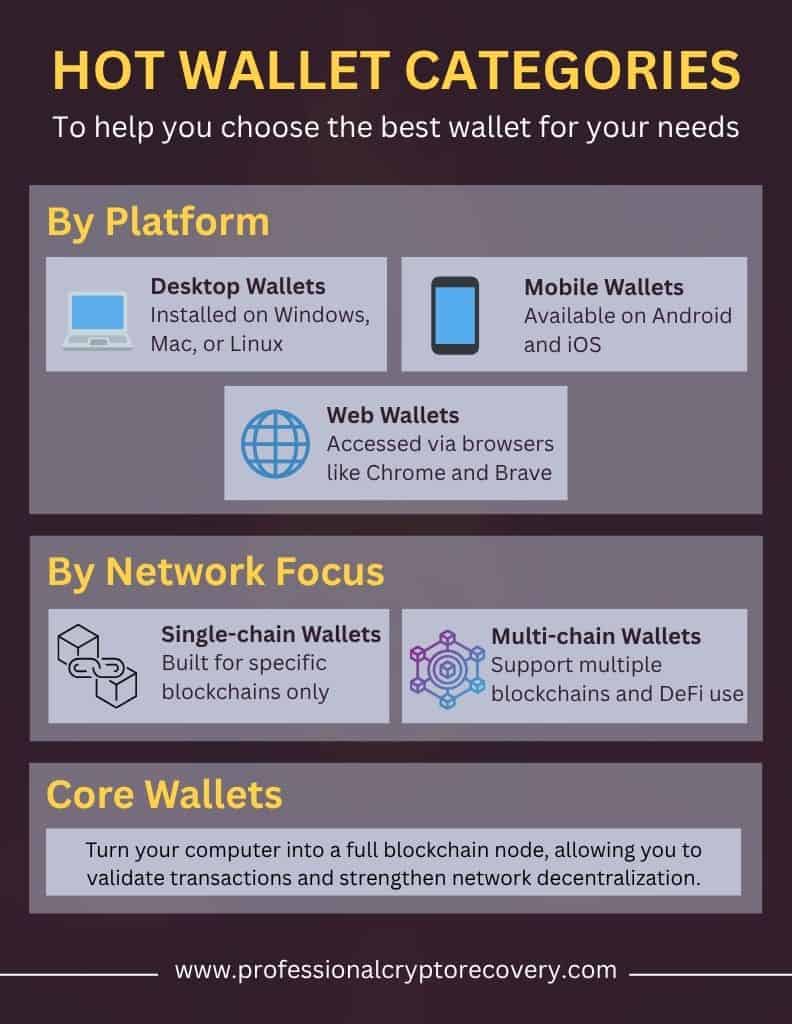
By Platform
Hot wallets are available on different platforms.
- Desktop wallets: These are software wallets installed on a computer (Windows, Mac, & Linux). Examples include Electrum, Sparrow Wallet, and Exodus. To install a desktop wallet, you have to download its installer from the official website.
- Mobile wallets: These are hot wallets available on Android and iOS smartphones and tablets. Examples include MetaMask, Trust Wallet, and MyEtherWallet. They can be found on mobile stores all across the internet. Nonetheless, you should only use the official stores.
- Web wallets: These are wallets that can be accessed on browser platforms like Chrome and Brave. Many mobile wallets have a browser version, with some, like blockchain.com, doing it on a secure website, while others, like MetaMask and Trust Wallet, have a browser extension.
By Network Focus
Based on their compatibility with blockchain networks, hot wallets can be categorized into:
- Single-chain wallets: Some hot wallets are built for specific onchain ecosystems. You cannot use them on any other blockchain as they are only compatible with assets and protocols built on their particular ecosystem. Most Bitcoin hot wallets fall in this category.
- Multi-chain wallets: Ethereum’s launch came with smart contracts and the Ethereum Virtual Machine (EVM), which paved the way for blockchain compatibility. Today, many blockchains and their assets are EVM-compatible, allowing for the creation of multi-chain wallets.
Multi-chain wallets are wallets that support multiple blockchains. With one, you can explore DeFi on different networks while storing assets from different ecosystems. Many modern hot wallets feature multi-chain support.
Core Wallets
Core wallets are a special type of software wallet. They turn your computer into a full blockchain node and let users contribute to transaction validation and verification, enhancing the network’s decentralization and security. Examples include Bitcoin Core and Litecoin Core.
Considerations
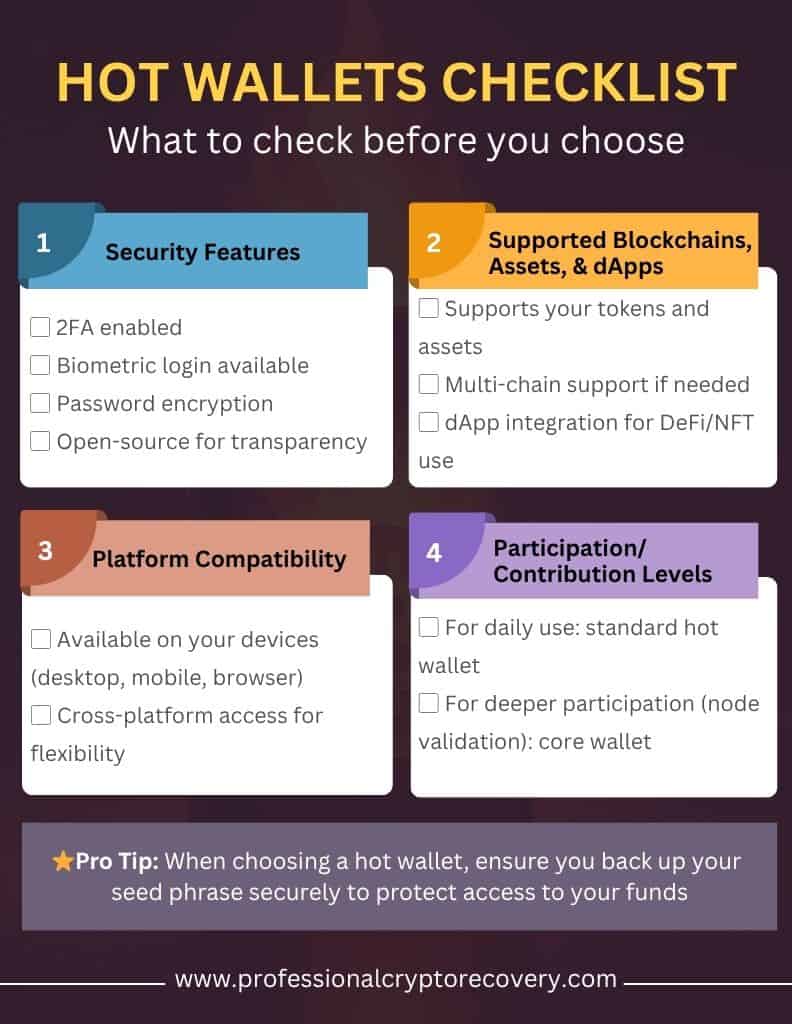
If you’re choosing a hot wallet, key considerations include:
1. Security Features
Security is the foundation of your crypto journey. Hot wallets may offer a lower level of security than cold wallets, but the best apps come with enough features to guarantee the safety of your assets if properly utilized.
Features like two-factor authentication (2FA), biometric login, and/or password encryption protect your crypto from unauthorized access using your devices. There is also the codebase for the app.
Some hot wallets are open-source, meaning that the code is freely available to view. This model guarantees a higher level of security than closed-source wallets because the community can audit the code, spot vulnerabilities, and suggest improvements.
2. Supported Blockchains, Assets, and dApps
Does the hot wallet support the tokens you need? Choosing a wallet that’s compatible with your target ecosystem is as crucial a consideration as security.
If you intend to explore different ecosystems, multi-chain support is a necessary feature. dApp integration is also a big consideration if you want to engage in decentralized finance. Modern hot wallets have features like built-in browsers and dApp connectors to make DeFi and NFT use convenient.
3. Platform Compatibility
You should also consider support for your devices (desktop, mobile, and browser). You want a wallet that’s compatible with what you have. It is even better if it is cross-platform, as this grants you access across multiple platforms.
Where or how you plan to use your hot wallet should also influence your choice. If you’re someone who moves around a lot and you still want the ability to transact regardless of location, a mobile wallet will serve you best.
4. Participation/Contribution Levels
What kind/level of participation are you looking for? The average hot wallet is designed to enable permissionless peer-to-peer transactions, trading, minting, voting, and even gaming. But if you’re looking for a deeper level of participation, like running a node, you’ll need a core wallet.
The Best Hot Wallets for Cryptocurrency
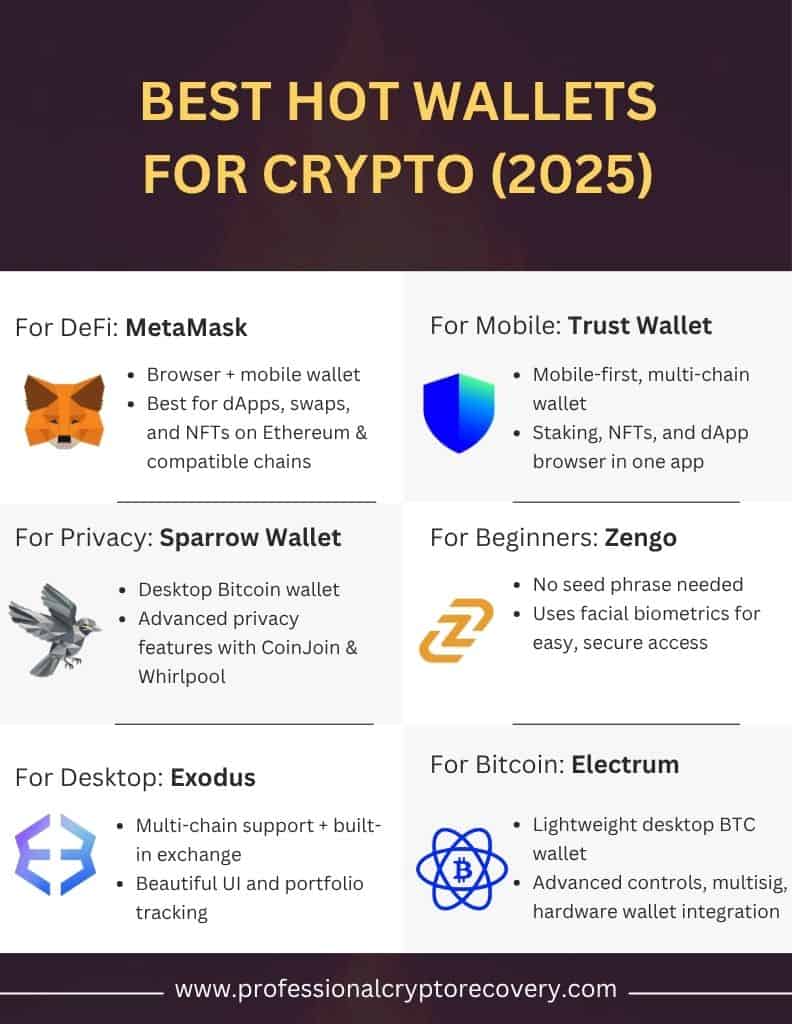
1. Best Hot Wallet for DeFi: MetaMask
MetaMask is a browser extension and mobile wallet designed for interacting with the Ethereum blockchain and compatible networks like BNB Chain and Polygon. It allows seamless connection to decentralized applications (dApps), making it a favorite for DeFi users.
MetaMask also features built-in token swapping, NFT support, and custom network integration. Its ease of use, dApp compatibility, and robust ecosystem are why it is widely considered the best wallet for DeFi.
2. Best Hot Wallet for Privacy: Sparrow Wallet
Sparrow Wallet is a privacy-focused desktop wallet designed for advanced Bitcoin users. It supports CoinJoin via Whirlpool, integrates with hardware wallets, and offers detailed control over transaction settings.
Its emphasis on privacy, transparency, and customizable security features makes it a top choice for users who prioritize anonymity and advanced Bitcoin management.
3. Best Hot Wallet for Desktop: Exodus
Exodus is a beautifully designed desktop wallet that supports a wide range of cryptocurrencies across multiple blockchains. It features a built-in exchange, portfolio tracker, and support for staking popular assets like Solana, Cardano, and Algorand.
Its intuitive interface makes it easy to manage assets and interact with Web3 apps. Exodus also offers seamless pairing with its mobile app and integration with the Trezor hardware wallet, making it ideal for desktop users who value both style and functionality.
4. Best Hot Wallet for Mobile: Trust Wallet
Trust Wallet is a mobile-first, multi-chain crypto wallet that supports thousands of assets across dozens of blockchains. It features an integrated dApp browser, staking capabilities, and NFT support.
The app combines a sleek user interface with powerful features, making it perfect for users seeking a comprehensive crypto experience on the go.
5. Best Hot Wallet for Beginners: Zengo
Zengo is a user-friendly crypto wallet that removes the complexity of private key management by using facial biometrics and threshold cryptography. It supports a range of assets and DeFi functionality while maintaining a simple, intuitive interface.
With no seed phrase to back up and strong security architecture, Zengo is ideal for newcomers looking for a safe, hassle-free entry into crypto.
6. Best Hot Wallet for Bitcoin: Electrum
Electrum is one of the oldest and most reliable Bitcoin wallets available for desktop. It is lightweight, fast, and offers advanced features like multi-signature support, custom transaction fees, and integration with hardware wallets. Power users appreciate its fine-grained control over transactions and security settings.
Best Hot Wallet Recovery
Hot wallets tend to be non-custodial. So during setup, the application gives you your private keys, usually a 12-24 word phrase that backs up your wallet. Some wallets may not give you such a phrase, but you retain full control and ownership of your keys.
This is a much-appreciated feature of non-custodial wallets. On the flipside, however, it places full responsibility for the security, backup, and recovery of the wallet on you. This is a straightforward task as long as you have your seed phrase and/or private keys backup.
But sometimes, seed phrases get lost, and backup files get corrupted. This complicates recovery and could even block you from accessing your funds. What you need, in this case, is the help of a wallet recovery expert.
Professional Crypto Recovery has got you covered. We have helped many crypto users who lost access to their Bitcoin, web3, and desktop hot wallets. Our services are quick, effective, and affordable, and we’ll take payments only after a successful recovery.
Contact us today to start your hot wallet recovery.
Frequently Asked Questions (FAQs)
What is a hot wallet, and how is it different from a cold wallet?
A hot wallet is connected to the internet and used for frequent transactions. A cold wallet is offline, offering greater security for long-term storage.
Are hot wallets safe for storing cryptocurrency?
Hot wallets are safe for daily use, but their online connection makes them vulnerable to hacks. Use strong passwords, enable 2FA, and store large amounts in a cold wallet to maximize security.
What happens if I lose access to my hot wallet?
If you have your seed phrase, you can recover your wallet. Without it, you risk losing funds permanently, though a crypto recovery expert can help recover your assets.
Can I use the same wallet on desktop and mobile?
Some wallets, like Trust Wallet and Exodus, offer both desktop and mobile versions. You can sync them using your seed phrase or QR code to use the same wallet on multiple platforms.
Can I stake crypto from a hot wallet?
Yes, many hot wallets support staking for coins like ETH, ADA, and SOL. It lets you earn rewards while keeping your assets accessible.