Public blockchains are designed to be transparent. Anyone, anywhere in the world, can access the data stored on the network. However, accessing information on a blockchain is not as easy as opening a file folder on your computer. The data is stored in a format that humans cannot read.
To access data on blockchains, humans use specialized tools, such as blockchain explorers.
A blockchain explorer is a web-based tool that lets you view and analyze data stored on a blockchain. Popular blockchain explorers include Etherscan, CoinMarketCap, BscScan, and Blockchain.com Explorer. They are the search engines of blockchains, just like Google and Bing are the search engines of the web.
Why Does a Blockchain Need a Search Engine?
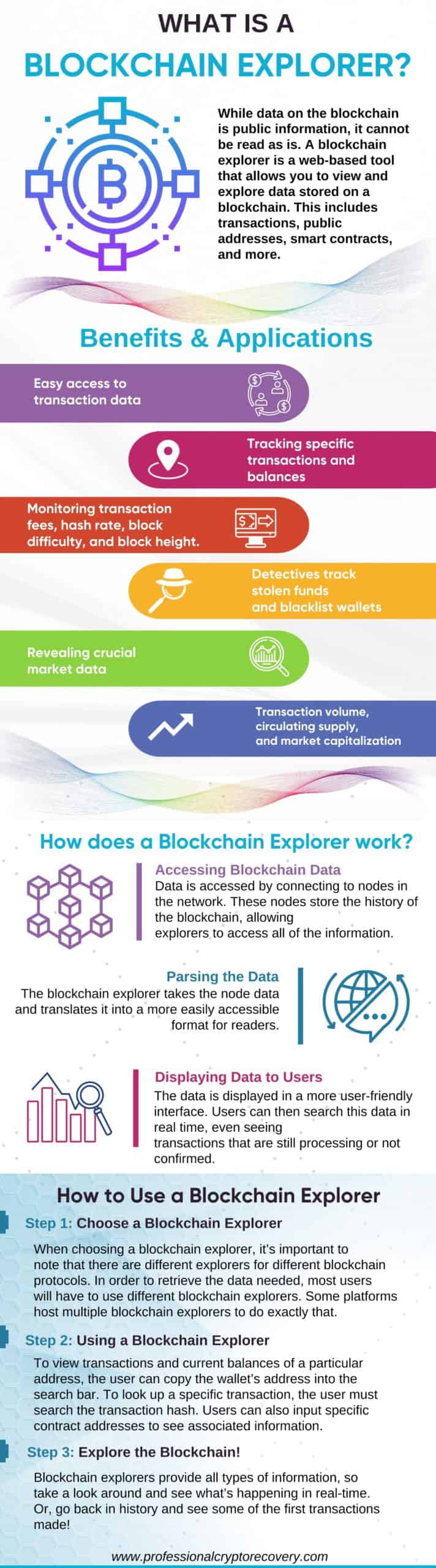
A blockchain is a decentralized ledger. It records all verified and approved transactions, which is a ton of information. It’s useful to traders and analysts, who regularly need it to make decisions in their line of work.
A blockchain explorer provides a convenient way for users to see this information. Blockchain explorers, or wallet apps, query the blockchain to get all transactions associated with a particular address. They then do the math to display the balance. With one of these tools, you can see any transaction information that you want.
For example, you can track specific transactions, check balances of wallet addresses, see which address is sending/receiving money to/from what address, and so on. You can also use it to see the transaction fees, hash rate, block difficulty, and the block height of a blockchain.
Blockchain explorers are a cool way to interact with blockchain technology. You get to play around with one of blockchain technology’s biggest features: its transparency.
A more serious application would be tracking certain addresses, like those belonging to whales. Whales are people who hold large amounts of cryptocurrency. And because of that, they can influence the market. Tracking their activities is a big part of due diligence for crypto traders.
There is also the issue of stolen funds. When hackers steal large sums of cash, detectives typically use blockchain explorers to track the movement of funds. They will know which wallets interact with the money. The wallets in question can become blacklisted and banned from exchanges.
Blockchain explorers reveal useful insights about a particular blockchain and its native token. For example, they provide crucial market data, such as an asset’s transaction volume, circulating supply, and market capitalization.
How Does a Blockchain Explorer work?
What blockchain explorers can achieve may seem like magic to some folks. Here’s how they do it:
Accessing Blockchain Data
A blockchain network is comprised of nodes. These are servers connected in a peer-to-peer network. Each one of them stores a complete copy of the blockchain.
To retrieve blockchain data, a blockchain explorer connects to the network’s nodes. It then receives access to all onchain information, including blocks and the transactions they contain, as well as all relevant information about them.
Parsing the Data
Data written on a blockchain is not in a human-readable form. So, once a blockchain explorer has access to this data, it performs what is probably its most crucial function: parsing it.
The tool parses through the data to extract all the relevant information that users may be interested in. It then interprets the data and transforms it into a human-readable form.
Displaying Data to Users
The information is now ready to be displayed to users. However, blockchain explorers don’t just throw the data at you in a PDF, spreadsheet, or CSV file. You can still get those formats if you want to, but it isn’t really necessary. These tools present the information in a user-friendly interface.
The UI of a blockchain explorer is designed to be as convenient as possible. You have search bars and filters that let you look for specific information. Some even include visualizations, such as graphs and charts, that make it easy to interpret the data.
The blockchain explorer is also connected to the nodes at all times. Translation? While using the tool, you get real-time updates. You can watch as new blocks are verified and new transactions are written on the ledger. Users can stay up to date on the latest blockchain activity.
Additional Features
There are additional features that let users do more than just look at the data. For example, experts can export the data to other tools for further analysis.
There are also Application Programming Interfaces (APIs), which are useful to developers. If you’re building an application, you can use an API to give your app access to the data being displayed by a blockchain explorer.
How to Use a Blockchain Explorer
There are many blockchain explorers. The specific steps of using one may vary depending on the platform you’re using. Generally, though, you only have to understand the user interface, and you’ll be good to go.
Here are some general things you might want to do, along with how to go about them.
Choosing a Blockchain Explorer
No two blockchain protocols are the same. Each network has its own unique architecture, nodes, consensus mechanism, and so on. That’s why each one demands a different kind of blockchain explorer.
You will not find a single explorer that provides information on both the Ethereum and Bitcoin blockchains. Instead, each explorer parses and displays information about one particular protocol.
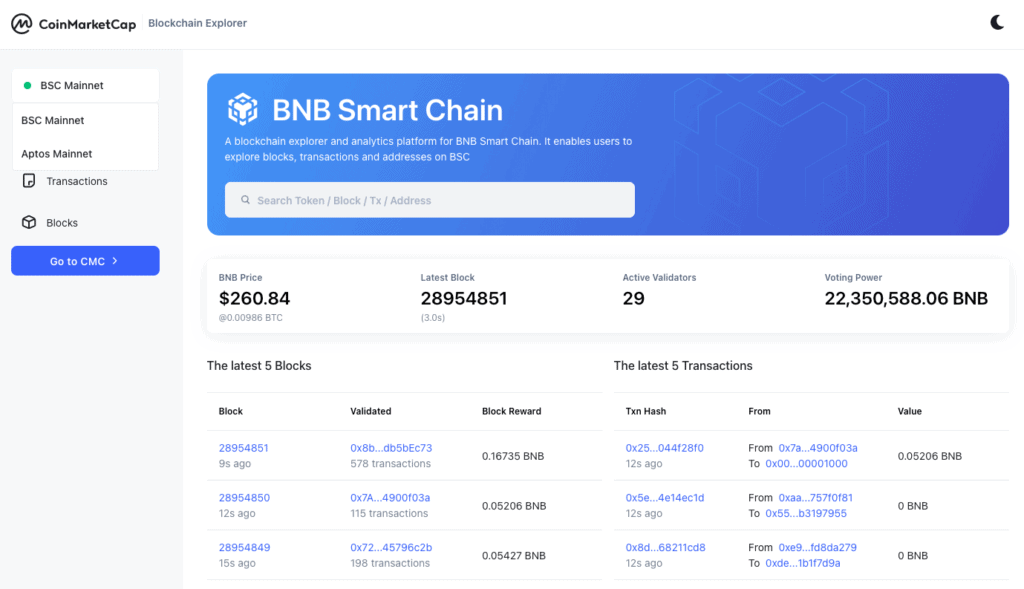
However, there are sites that host multiple block explorers for multiple blockchains. For example, CoinMarketCap has two explorers, one for the BNB Smart Chain (BSC) and the other for the Aptos Chain.
Using a Blockchain Explorer
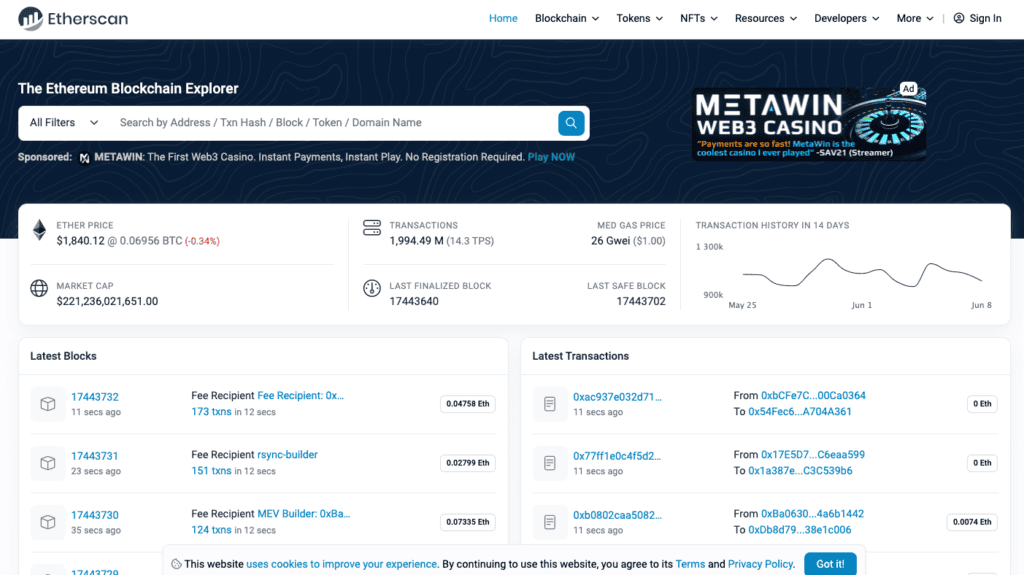
Most blockchain explorers greet you with general information on their home page. This information depends on the blockchain you’re checking out.
It might include the price of the protocol’s native cryptocurrency, its circulating supply, and the number of transactions processed per second. There may also be the latest number of transactions, the latest number of blocks, and the block rewards.
There is typically a button for viewing all transactions that have ever been processed on the network. The information displayed will include the wallet addresses involved, the transaction time, and the amount transacted. This ‘view-all’ feature is useful for people who want to do in-depth analysis.
You can use a blockchain explorer to do a lot of other things. For example, you can view your wallet address, or any address for that matter, and acquire information like its transaction history and the value of assets held in that address. All you need to do is paste the wallet’s address into the search bar.
The same applies when checking a particular transaction or block. To find a transaction, you need to search for its hash. It’s a string of numbers and letters generated when someone makes a transaction. It acts as the transaction’s unique ID on the blockchain.
If you’re a researcher doing extensive analysis on a particular chain or token, you’ll want to export the relevant data, especially if there is a lot of it. Some blockchain explorers may include useful charts and graphics to help visualize the information.
Popular Blockchain Explorers
There are many blockchain explorers. Popular ones include:
EtherScan
Etherscan was created in 2015 by a group of developers and blockchain enthusiasts. Their leader is a blockchain developer named Matthew Tan. EtherScan is an essential tool for developers building decentralized applications (dApps) and traders and investors dealing in ERC-20 tokens.
BscScan
BscScan serves the BNB Smart Chain (BSC). It was launched in April 2021 to provide reliable and up-to-date information on the BNB Smart Chain. The explorer is a product of Etherscan.
CoinMarketCap
CoinMarketCap is another popular blockchain explorer. It is a platform that hosts blockchain explorers for two different blockchains: BNB Smart Chain and Aptos. You will find that it has a more beginner-friendly UI than other blockchain explorers.
Blockchain.com Explorer
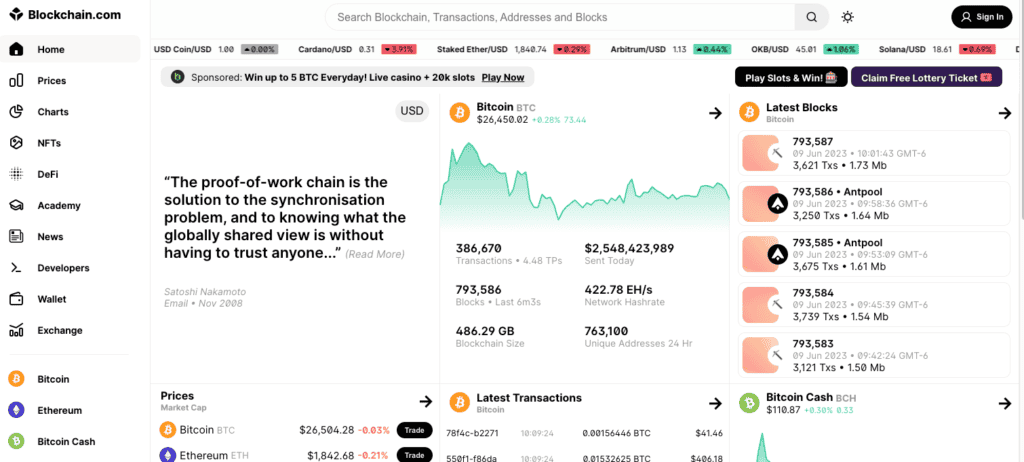
Blockchain.com Explorer is a product of the company Blockchain.com. It is a website that hosts explorers for multiple blockchains.
The platform hosts blockchain explorers for Bitcoin, Ethereum, and Bitcoin Cash. There are also explorers for the Bitcoin Testnet and the Bitcoin Cash Testnet. All of these use charts and graphs to help visualize their data.
Bitaps
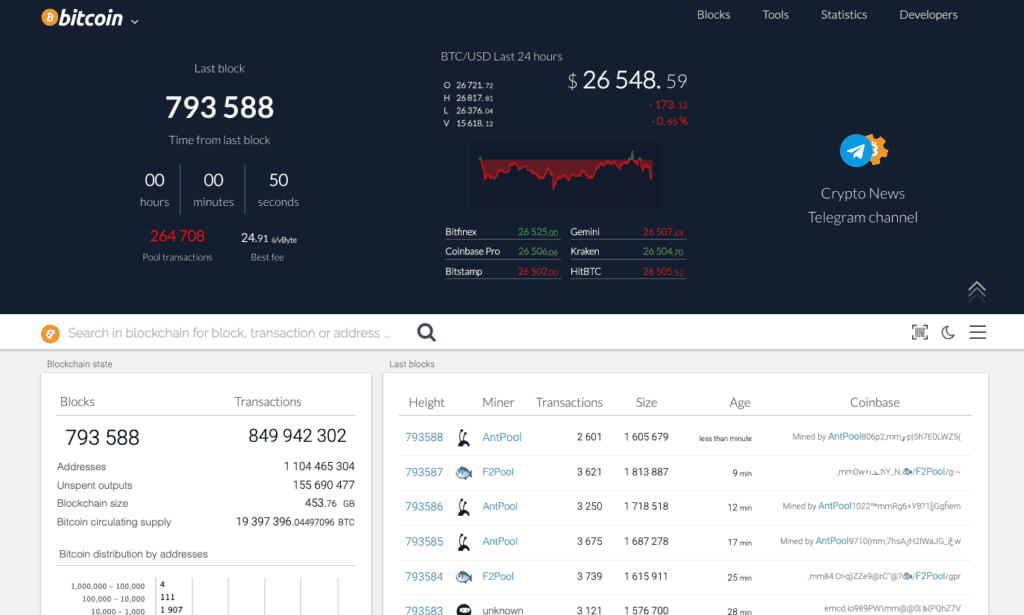
Bitaps is a blockchain explorer for the Bitcoin, Litecoin, and Ethereum blockchains. In addition to providing a way to explore blockchains, the platform offers APIs and developer tools that enable applications and businesses to access real-time data from the protocol.
The Explorer was created by a team of developers based in Europe. It is now managed by Bitaps Technologies LLC, a company also headquartered in Europe.
Blockchain Explorers Are a Great Asset for Everyone’s Crypto Tool Kit
Blockchain explorers are crucial tools in the crypto ecosystem. Everyone, from traders to government agencies, developers, and enthusiasts, uses these tools to view on-chain data. They provide useful insight into a blockchain protocol, making them absolutely indispensable.