Web3 consists of many different protocols and assets. This has led to the creation of a variety of wallet types, each built to interact with and manage a particular asset(s) across one or multiple blockchains.
Of all wallet types, EVM wallets are the most widespread. Popular platforms like MetaMask and TrustWallet have over 100 million users, while Base, a relatively recent entrant, has over 70 million. So, what makes these wallets special?
Let’s explore EVM wallets, from the basics of how they work and their pros and cons, to choosing a wallet and troubleshooting tips.
What Is an EVM Wallet?
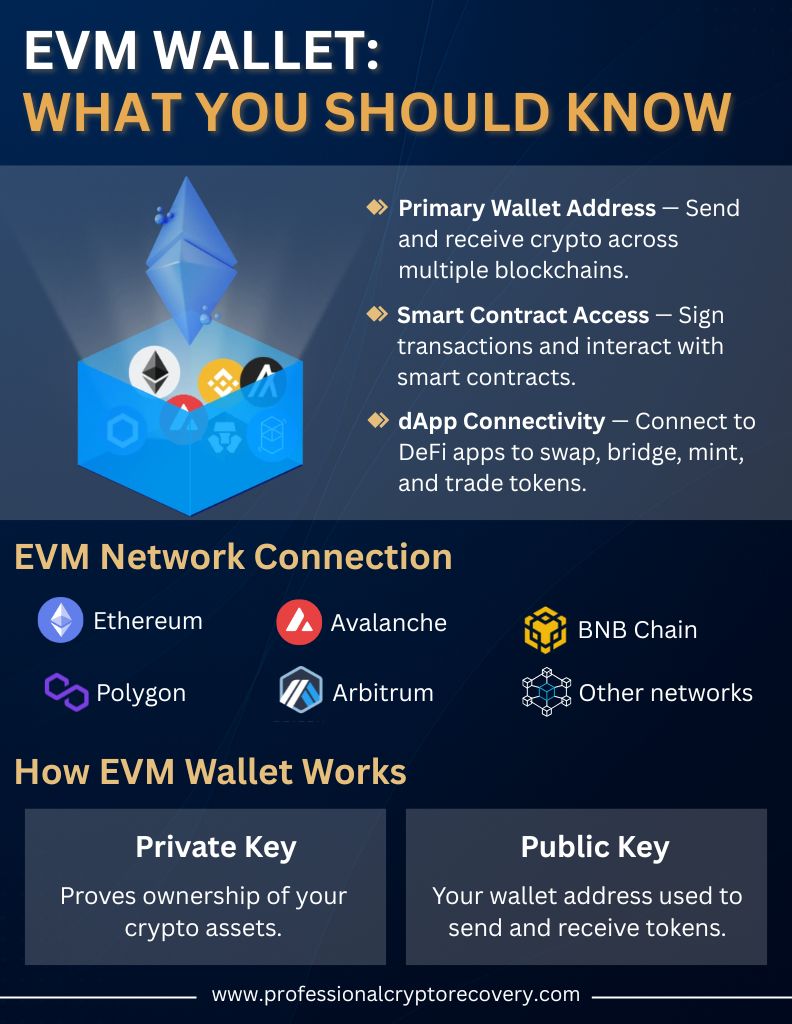
An EVM wallet is a crypto wallet that supports networks compatible with the Ethereum Virtual Machine (EVM). Examples are Ethereum, BNB Chain, Arbitrum, Polygon, and Avalanche, to name a few.
A single EVM wallet is typically compatible with most, if not all, EVM blockchains. This allows you to send and receive crypto across multiple chains from your single address. You also get to participate in decentralized finance (DeFi).
Leveraging the capabilities of the Ethereum Virtual Machine, EVM wallets let you interact with decentralized applications (dApps) and sign smart contracts. This connects you to the wider web3 ecosystem, letting you swap, bridge, and mint tokens on-chain.
Understanding the Ethereum Virtual Machine (EVM)
EVM is the computational engine of the Ethereum network and several other blockchains. It is a machine that executes smart contracts and maintains a global state by tracking the current state of all accounts and contracts on the network.
EVM is not a physical computer. It is, instead, a virtual machine that can run code and execute programs. It exists entirely on the blockchain and is maintained by the distributed network of nodes that make up the blockchain.
How Do EVM Wallets Work?
EVM wallets work just like any other crypto wallet.
- Public keys serve as the wallet address used to send you crypto.
- Private keys prove ownership of funds in the wallet.
These wallets are non-custodial. They leave you in charge of your private keys, giving you full ownership and control over your assets. You’ll typically receive a phrase of 12-24 randomly generated words that act as a mnemonic for your private keys.
As long as you have this phrase, you can always access your crypto.
How to Get and Use an EVM Wallet
Today, it is easy to find and use EVM wallets. This is in no small part because many EVM projects are open source, making them available to download and install for free on your phone or computer.
Set up is relatively straightforward. You don’t have to register for an account or provide personal data to create a wallet. Once you set a password and record the recovery phrase, you’re good to go.
Note that most EVM wallets default to Ethereum. Depending on your intended use, you may want to add other EVM-compatible blockchains. Some wallets have tools that automate this process.
Others require you to manually provide network details like Chain ID and RPC URL.
Core Features of an EVM Wallet
Compared to other wallets, i.e., Bitcoin wallets, EVM wallets have some key features:
- Multi-chain integration: EVM isn’t exclusive to Ethereum. It is used by other chains, like Polygon, Avalanche, BNB Chain, etc. So, EVM wallets tend to support many blockchains.
- Multi-asset support: EVM wallets support all ERC-20 tokens. These include ETH, USDT, USDC, BNB, and a whole host of other altcoins, memecoins, and non-fungible tokens (NFTs).
- dApp integration: EVM wallets let you interact with on-chain apps to mint, swap, and bridge assets.
Many EVM wallet apps now feature built-in dApp integration. So, you don’t have to visit an external website to use a dApp. You can do it all in the wallet.
Pros and Cons of Using an EVM Wallet
EVM Wallet Benefits
Easy to Use
User experience (UX) on crypto platforms has improved a lot. Now, creating and using an EVM wallet is easy. There is no signup process or Know Your Customer (KYC) requirement.
Non-Custodial Ownership
Most EVM wallets are non-custodial. By giving you your private keys, they enable true ownership. You can send, receive, and withdraw crypto from your wallet as you wish.
Smart Contract Interactions
EVM wallets are built for smart contract interactions. This empowers you to use other dApps in the DeFi ecosystem, from decentralized exchanges and liquidity pools to bridges and crypto mixers.
Interoperability
EVM was invented on Ethereum. Since then, it has been adopted by other blockchains. These EVM-compatible networks include Binance Smart Chain (BSC), Avalanche, Cardano, Fantom, and Polygon.
Your EVM wallet works on all these chains. So, instead of having a wallet for each blockchain, you have one for all.
EVM Wallet Cons
EVM wallets don’t have many cons. The only downside is that, being hot wallets, they are more vulnerable to hacking and phishing attacks than hardware wallets.
How to Choose the Right EVM Wallet
The right EVM wallet for you depends on several factors.
- User Interface (UI): A wallet’s UI determines the UX. Depending on whether you’re a new or advanced user, you’ll look for a clean, intuitive interface or one that offers more customization and control.
- dApp Support: EVM wallets generally have good dApp support, but some apps do it better than others. This is a big factor if you intend to participate in the wider ecosystem.
- Security: There are many EVM wallets out there. Since these platforms are often targeted by hackers and scammers, security is one of the most important considerations. Make sure to download your wallet from official stores or websites.
Security Risks to Watch Out For When Using EVM Wallets
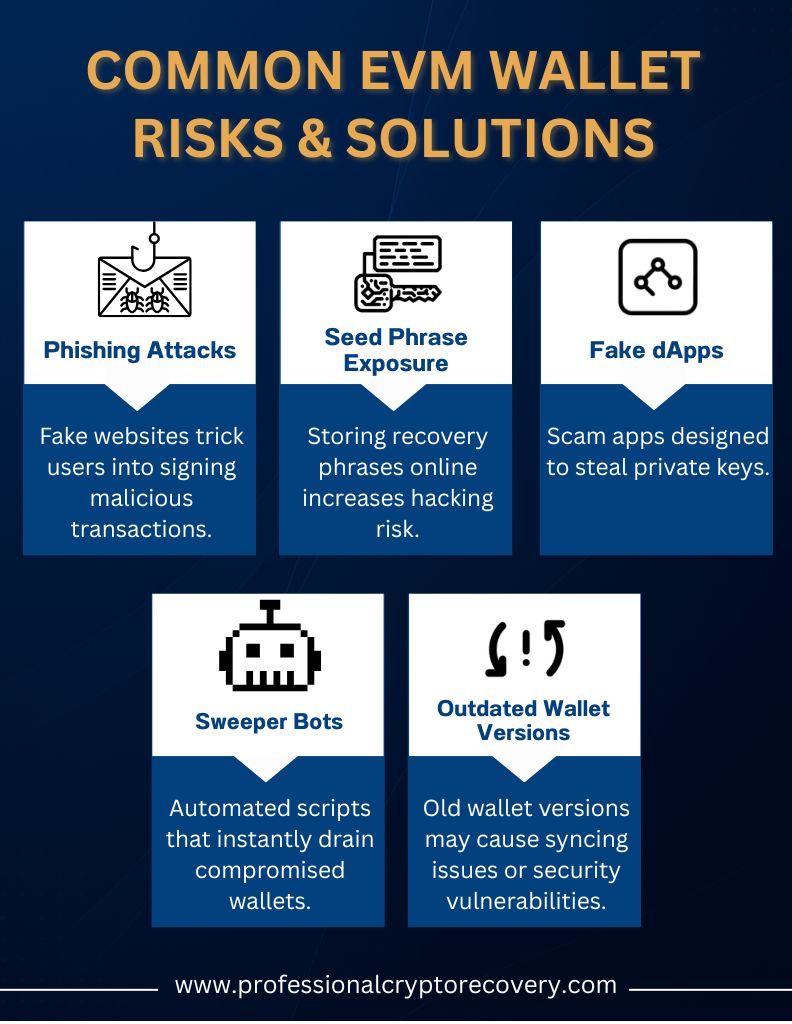
Most EVM wallets are pretty secure platforms to store and manage your assets. Still, users are advised to remain vigilant against:
- Phishing scams
Phishing involves scams where attackers trick the user into signing a malicious transaction or revealing their private keys. This is common in crypto, but in recent years, the use of AI-generated phishing content has made attacks harder to detect.
- Seed phrase compromise
Your seed phrase can be stolen if you don’t store it properly. For example, seed phrases stored online in apps and cloud backups are vulnerable to hacking.
- Fake dApps
Hackers have created fake but convincing mimics of legitimate wallets and dApps. These are designed to steal your private keys. So, make sure you download your wallet app only from official sources and double-check a dApp url before interacting with it.
- Sweeper bots
Sweeper bots are malicious scripts designed to empty your wallet. Once compromised, any crypto sent to your address will be diverted faster than you can block the transaction. Thus, make sure to scrutinize any smart contract before interacting with it.
Best EVM Wallets to Choose From
There are many good EVM wallets to choose from. The top 5 are:
- Metamask
Metamask is the most popular EVM wallet. With a good reputation for reliability, user experience, and robust dApp integration, the wallet has millions of users across web and mobile.
- Trust Wallet
Trust Wallet is another popular EVM wallet. Originally launched as an Ethereum-only platform, the wallet now lets you conduct transfers and interact with dApps across multiple chains.
- Base App
Coinbase, one of the largest crypto exchanges, built a non-custodial wallet, Coinbase Wallet. This is now Base App, an “everything app” that combines on-chain payments, trading, and social networking.
- Rabby Wallet
Rabby is an open-source EVM wallet that supports over 100 chains and integrates with Ledger, Trezor, and other hardware wallets. It is available as a mobile app and browser extension.
- Rainbow Wallet
Rainbow wallet is an EVM wallet designed with an extra focus on user experience. It provides a simple and secure way to get started with DeFi.
EVM Wallet Issues and How to Fix Them
- Forgotten password
If you forget your wallet’s password, you cannot open it to access your funds. You’ll need to use your seed phrase to recover your wallet.
If your phrase is invalid or isn’t bringing up your assets, contact a recovery expert. They can help you recover your wallet and access your crypto.
- Forgotten or lost seed phrase
Your seed phrase is your wallet’s ultimate backup. There is no way to recover your wallet if you lose it. Nonetheless, if you have a partial seed phrase, a crypto recovery professional may be able to help you.
- Outdated Wallet Versions
Being software, EVM wallets need to be the latest version to work. Users on outdated versions experience syncing issues and risk their security. Sometimes an outdated wallet will refuse to work completely.
Contact a wallet recovery professional if you need help accessing assets in an outdated wallet.
Professional EVM Wallet Recovery
EVM wallets are the most widely available crypto wallets. They also offer the most robust functionality, allowing users to swap, bridge, and mint tokens, on top of conducting peer-to-peer transactions. As such, they are the most popular crypto wallets today.
EVM wallets are non-custodial, however. This means that in case you lose access to your wallets, the developers can’t help you. You’ll have to recover the wallet yourself, or failing to do so, seek the services of a crypto recovery professional.
Professional Crypto Recovery is a wallet recovery business with decades of experience in IT and data recovery. If you’ve lost your EVM wallet and cannot recover it yourself, reach out today. A recovery professional will get back to you to discuss your case.