Ask any crypto user what their main worry is, and you’ll probably hear the same answer a lot: crypto wallet security.
In a recent survey by Kraken, the majority of respondents said security was a top concern, and many even said it’s holding them back from investing more.
Keeping your crypto secure starts, for most people, with your wallet. Today’s crypto wallets are equipped with a ton of security features and encryption to keep your funds and private keys as safe as possible.
But how does crypto and bitcoin wallet encryption actually work? It’s something every crypto holder should understand, so we put together this article to show you how crypto wallet security and encryption work together, why it matters, and what you can do to keep your wallet as secure as possible.
Understanding How Crypto Wallet Security Works
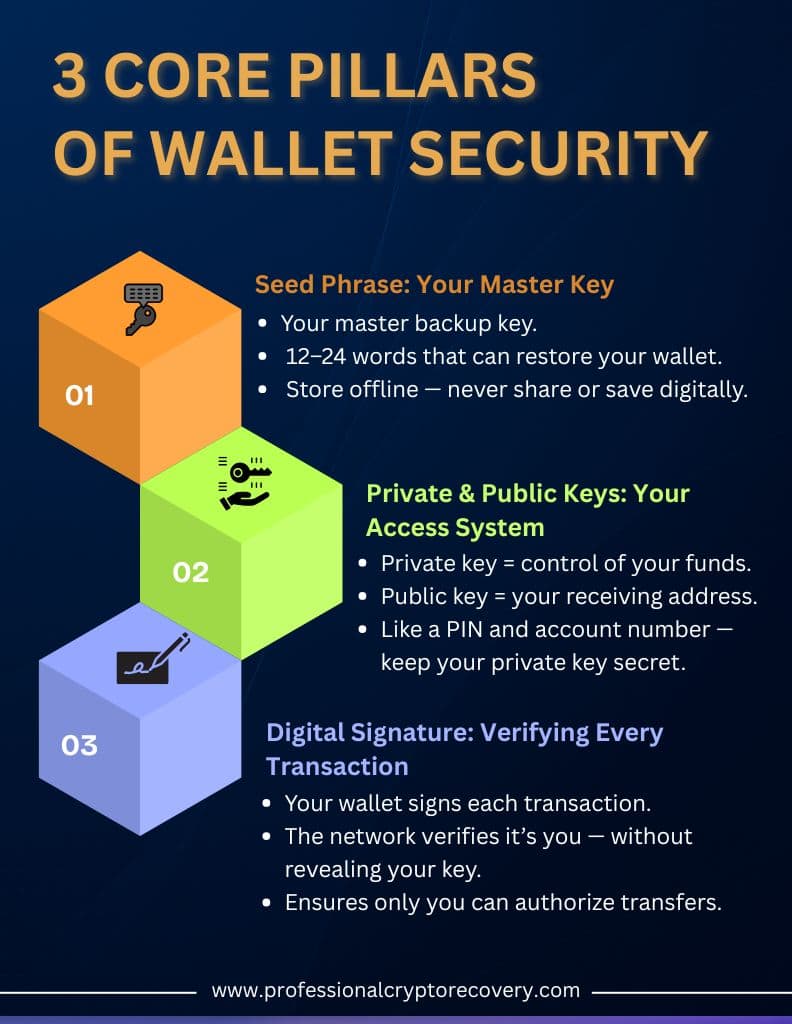
To understand crypto wallet security, you should first know that crypto wallets don’t actually contain any coins. Instead, your wallet is home to your private key and seed phrase, which together allow you to access and control your funds.
The Seed Phrase
Your seed phrase is a unique list of words that allows you to access your funds on-chain. Anyone who has access to this phrase will have full control over your assets and every account associated with it.
Because of this, it’s incredibly important to keep your seed phrase safe and completely secret. Never store it digitally; instead, write it down (on paper or ideally metal) and store it in multiple secure physical locations that only you can access.
Private and Public Keys
Your private and public keys are two unique strings of random letters and numbers that work together to keep your wallet safe. Let’s break it down.
Your private key gives you full control over your wallet and funds, and you should never share it with anyone. Your public key, on the other hand, is what you share with others if you want to receive crypto.
It might help to think of your private key as your PIN number, and your public key as your account number.
Digital Signature for Transactions
Whenever you make a transaction, your wallet uses your private key to create a digital signature. This tells the network that you, and nobody else, authorized the transaction, without revealing your private key. It’s a way of making sure that only the owner of the private key can control their funds.
What Is Crypto Wallet Encryption?
Encryption is one of the most important elements of crypto security, but it’s also often misunderstood.
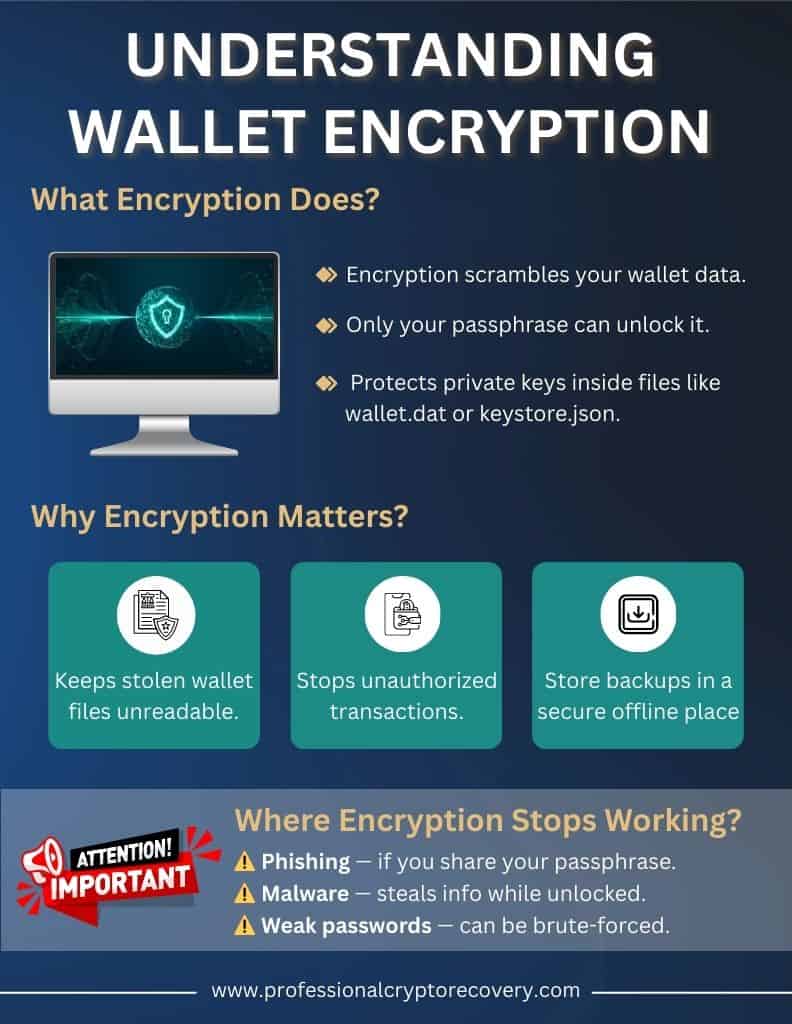
In simple terms, wallet encryption scrambles the data in your wallet so that you can only access it with the right passphrase, which you choose. Different wallets handle encryption slightly differently.
For example, Bitcoin Core uses a “wallet.dat” file that holds all your private keys. In wallets like Geth, Parity, and MetaMask, your keys are stored in a “keystore” JSON file.
Role of Encryption in Crypto Wallet Security
Encryption is a solid part of crypto wallet security, but it’s not the only one. Let’s take a look at the main benefits of encryption, as well as a few areas where it’s not quite enough.
Benefits of Crypto Wallet Encryption
Here are the main benefits of crypto or Bitcoin wallet encryption:
- It protects data at rest. This means that even if someone manages to steal or copy your encrypted wallet file, they can’t access the info without your passphrase. This is even true if malware steals your file.
- It prevents unauthorized spending of your funds. Even if thieves get hold of your device, hard drive, wallet file, or backup, they won’t be able to spend your crypto without the passphrase (as long as you have a strong password).
- It allows for safer backups. When you keep encrypted wallet backups, for example, on USB drives or cloud storage, the information inside is still protected by your passphrase, even if those backups are compromised. However, you should never store your backup files online.
What Encryption Can’t Prevent
Now, let’s look at a few areas where encryption falls short, and where you’ll need other security features in place.
It’s important to note that encryption only protects data while your wallet is locked. What does this mean? Well, once you use your passphrase to unlock and open your wallet (for example, to send a transaction), the keys are usable.
Here’s what encryption does not defend against:
- Phishing scams. If a scammer tricks you into sharing your passphrase, encryption can no longer help you. Some phishing scams might even get you to share your private key outright.
- Malware, like keyloggers, can capture your password as you type or grab keys while the wallet is unlocked. In this case, hackers will get the information they need to decrypt your wallet, and encryption can no longer protect your funds.
- If your passphrase is weak, short, or easily guessable, hackers might be able to decipher it by brute force. Encryption relies on good passwords.
- Human error, like losing your passphrase or falling for social engineering attacks.
Encryption as One Layer in a Broader Security Stack
You can think of encryption as one tool in your overall crypto wallet security toolkit. It‘s very effective at what it does, but it’s really just one defense among many.
Here are some of the other important elements of crypto wallet security:
- Cold storage, where you store your keys completely offline to reduce any risk of a hack or breach.
- Strong passwords that can’t be guessed by brute force. The best passwords are long, random, completely unique, and use a combination of letters, numbers, and symbols.
- Hardware wallets, like Ledger, are a form of cold storage. They store your private keys on a tamper-resistant chip and never expose them to the computer. No software can be installed on these wallets.
- Two-factor authentication on any services related to your wallet.
- Full-disk encryption on any devices you use to interact with your wallet, like your laptop or smartphone.
- Good user habits like verifying website URLs, avoiding untrusted links, and being cautious on public Wi-Fi.
Best Practices for Crypto Wallet Security
Crypto wallet security works best when you take the right steps to support it.
Here are some best practices to help you get the most out of your wallet’s security features and keep your funds protected:
- Use a strong, unique passphrase for your wallet. Make sure it’s 16+ characters long, includes letters, numbers, and symbols, and is completely unique and not reused anywhere else. It might help to use a password manager to generate and store a secure password.
- Proactively enable encryption whenever possible. Encryption might not always be a default setting, so be sure to set it up.
- Back up your seed phrase and wallet data securely, and store this information in a highly secure offline place like your home or a safe deposit box.
- Be vigilant for phishing scams, where hackers pose as trusted entities and ask for your personal information. Don’t ever share your private key with anyone: wallet platforms will never ask for this information. Always double-check URLs and sources, and only download wallet software from highly trusted sites and app stores.
- Keep your wallet app and device operating systems updated with the most recent software at all times, since these updates often include important security fixes.
If your crypto portfolio is very high in value, you’ll need to be even more diligent about your security. Use a multi-signature setup, enable two-factor authentication on any exchange or service account that interfaces with your wallet, and keep the bulk of your funds in cold storage in an extremely safe location like a bank vault.
How PCR Can Help With Your Crypto Wallet Security
If you lose access to your crypto funds, it can feel like crypto wallet security is working against you. Without information like your passphrase, it’s extremely difficult to regain access to your assets.
But not all hope is lost. At PCR, we specialize in helping crypto users recover lost crypto. Whether it’s a forgotten password, an outdated wallet version, accidentally deleted data, or a security issue like a sweeper bot, we can help.
Get in touch with us to learn more.
Frequently Asked Questions
How secure is a crypto wallet?
Crypto wallets today have lots of powerful security features like strong encryption, two-factor authentication, and even biometric logins. They are designed to keep your funds safe, but you still have to follow best practices like setting strong passwords, enabling features like encryption, keeping software updated, and being aware of phishing scams.
What is the best security wallet for crypto?
There are lots of excellent crypto wallets out there with strong and reliable security features. Hardware wallets like the ones made by Ledger and Trezor are among the most secure. Software wallets like MetaMask, Trust Wallet, and Coinbase Wallet are more user-friendly and convenient, but are more vulnerable to hacks and require you to be more vigilant with security.
How do I keep my crypto wallet secure?
Choose a reputable wallet with strong security features, enable encryption, set a strong and unique password, keep software updated at all times, back up your seed phrase and wallet data securely, and be vigilant for social engineering scams like phishing.
Can a crypto wallet be hacked?
Yes, software wallets that are stored on your devices can be hacked and infiltrated. If criminals get hold of your passphrase, they can access your funds. Hardware wallets are typically more secure since they exist completely offline.