If you are going to take crypto seriously, you’ll want the best cold wallet you can get your hands on. Ask any expert, and they’ll likely tell you that cold wallets offer the best security because they store your private keys in an offline environment.
Because storing data online makes a wallet more vulnerable to cyberattacks, cold storage is considered more secure than hot storage. Because fund safety should be a priority for all crypto users, cold wallets are considered the best choice in the space.
How Does a Cold Wallet Work?
Crypto coins and tokens are data. That data doesn’t live in your crypto wallet, though. It’s stored on the blockchain. To learn about this in detail, check out our article on how cryptocurrency is actually stored.
The way digital assets are stored means crypto wallets are not traditional wallets. They are more like tools for accessing the data (coins and tokens) that you own. To function, they use a combination of cryptographic keys, one private and the other public.
The public key represents your wallet’s address on the blockchain. It is what you give to people looking to send you crypto coins and tokens.
The private key, on the other hand, is what lets you access all the coins and tokens sent to your wallet address. It is the master key to all your assets on the blockchain. When transferring assets from your wallet to another, it acts as the digital signature, signing off on transactions.
Securing your private key should be more than an afterthought. Anyone who gets their hands on it can access your crypto assets at will. And the world has more than its fair share of malicious actors trying to steal private keys.
Among these are online hackers who target private keys stored online. To prevent that, cold storage solutions keep your private keys offline at all times. Transactions are signed in an offline environment before being broadcast, keeping hackers marauding within the network from ever seeing the keys.
It’s also important to note that all cold wallets are non-custodial wallets. You control your private keys.
What Are the Different Types of Cold Wallets?
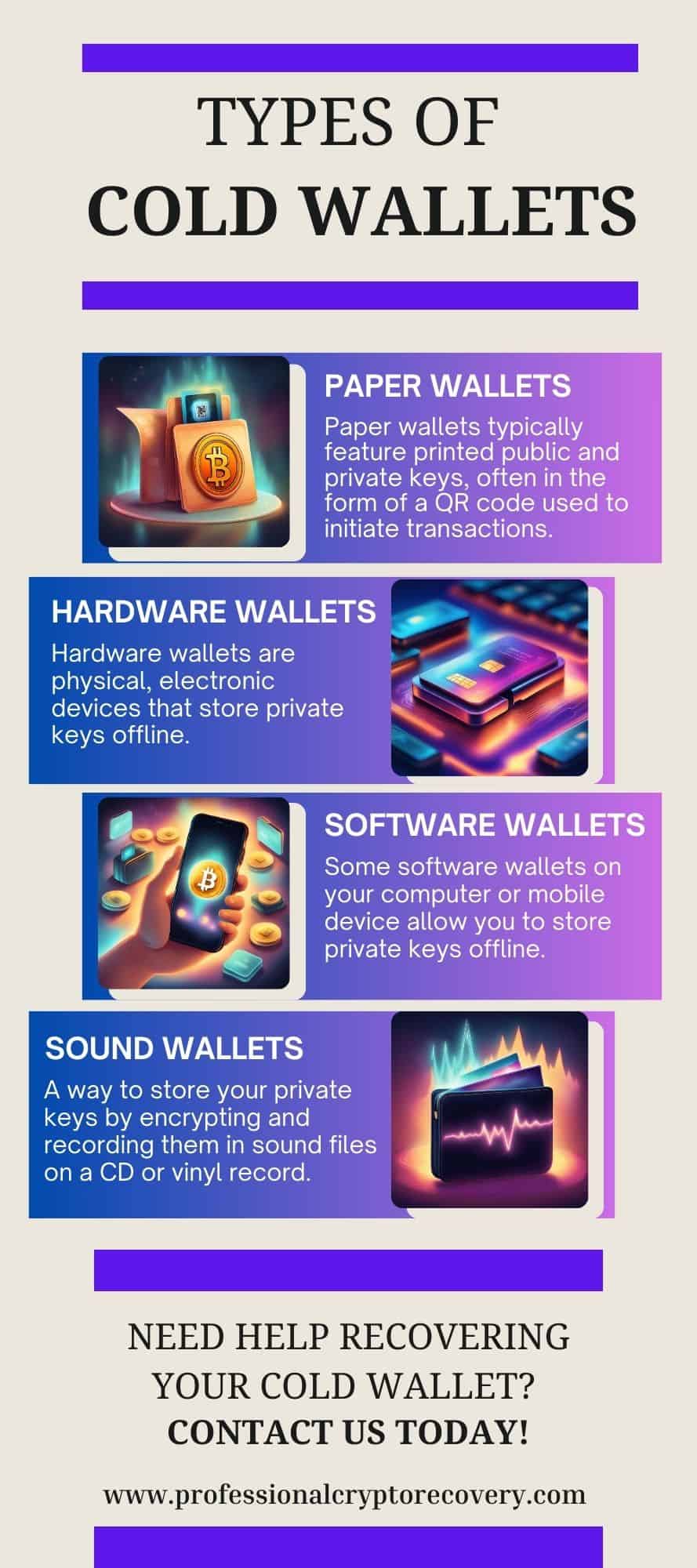
Various crypto wallets use different approaches to cold storage, resulting in different types of cold wallets. These are:
Paper Wallets
Paper wallets are the simplest form of cold wallets. They are papers on which public and private keys have been printed, usually in the form of a quick response (QR) code that is scanned to initiate a transaction.
A paper wallet is fairly easy to create. You’ll need a website or app that lets you generate public and private keys, which you can then print. But in the spirit of cold storage, the entire process has to be done offline. Neither the device you use nor the printer it is connected to should be connected to the internet.
But you should be aware of the drawbacks of this medium before doing any of that. The biggest of these is that paper is fragile, easily torn, or otherwise damaged. If that happens, you may lose access to your keys, which also means losing access to your assets.
The same is true if you lose the piece of paper. Paper wallets have largely fallen out of favor in the crypto space. Many people have, instead, turned to hardware wallets for their cold storage needs.
Hardware Wallets
Hardware wallets are physical, electronic devices that store private keys offline. There is a whole industry dedicated to manufacturing and improving them. It is dominated by two brands, Ledger and Trezor.
During setup, a hardware wallet provides a seed phrase that contains your public and private keys. You’ll also be required to set up a PIN or password to prevent unauthorized access.
On their own, hardware wallets cannot connect to the internet. They are air-gapped wallets, meaning you will need to connect the wallet to a phone or computer to use it.
Most hardware wallet devices look and function like a USB drive. All you need to do is plug it in.
There are also a few wireless models that connect to a phone/computer via Bluetooth.
Either way, the private keys are generated within the hardware wallet by a secure smart card that is always offline. So, even when the phone/computer is connected to the internet, the keys remain out of reach of hackers.
However, that doesn’t guarantee that your assets cannot be stolen. There are other ways that you can lose your crypto, even with the secure cold storage offered by hardware wallets.
For example, since it is a physical device, your hardware wallet can be physically stolen. And if whoever has it gets their hands on your PIN, all they need to do is plug the device into a computer and enter the PIN to access your assets. Fortunately, this scenario can be avoided with a passphrase.
Your assets will also be unsafe if an unauthorized person discovers your seed phrase. This is because they can use it to generate your keys and steal from you.
Offline Software Wallets
There are also software wallets you can download on your computer/mobile device that store private keys offline. Examples include Electrum and Armory. Not all of them offer the option of signing transactions offline, so do your research before you go down this road.
You will not be required to keep your device offline to use an offline software wallet. In fact, like all software wallets, these require an internet connection to work. So, how do they keep your private keys offline?
The wallet is split into two platforms: one online and the other offline. When sending crypto, the online platform generates an unsigned transaction. This is then moved to the offline platform, signed with the private key, and returned to the online platform. Now, as a signed transaction, it is finally broadcast to the network.
Offline software wallets, however, are not as secure as hardware wallets. The computer on which a software wallet is installed can itself be hacked (and it’s not that hard). And since the keys are stored locally, the attacker may be able to obtain them.
Sound Wallets
Sound wallets are a way to store your private keys by encrypting and recording them on a compact disc (CD) or a vinyl record. Once encrypted, the keys can only be deciphered using a spectroscope.
However, while novel, this form of cold storage is considered extreme. It’s also expensive because it requires specialized components. Few people use sound wallets to store their keys.
Advantages and Disadvantages of Cold Wallets
The biggest advantage of cold storage is security. Compared to hot wallets, cold wallets are more secure because private keys are always offline, which keeps them out of reach of online hackers. But there are disadvantages.
One of these is cost. The best cold storage solutions, i.e., hardware wallets, are manufactured commercially by companies. So, you have to purchase them, unlike hot wallets, which are almost always free to download and use. Hardware wallet prices start at $70.
The other disadvantage is convenience. Cold wallets are not nearly as convenient to use as hot ones, especially for high-frequency traders. They are not connected to the internet and require additional steps to use.
For example, with a hardware wallet, you need to connect it to your phone/computer before you can sign transactions, which takes time. It gets even worse with paper and sound wallets, which require scanning QR codes and decrypting sound waves.
For this reason, people who conduct many transactions try to avoid cold storage solutions. They prefer to hold their assets in hot wallets, which offer greater convenience for trading.
The last disadvantage is the risk of loss, theft, or damage. Unlike offline software wallets, cold wallets store private keys on a physical medium. That medium can suffer physical damage, get lost, or be stolen.
Handle your cold wallet carefully and store it somewhere secure. The location should be protected from the elements and would-be thieves. Something like a safe is perfect. And also…keep your mouth shut. Don’t brag about crypto trades or fat bags of Bitcoin. If people don’t know what you’re doing, they don’t have any reason to show up to your house to rob you.
The Top 3 Cold Wallets
The best cold wallets are hardware wallets. Compared to paper, sound, and offline software wallets, they are easy to use, have advanced security features, and support multiple cryptocurrencies. Here’s a look at the best three cold wallets.
1. The Best Overall Cold Wallet
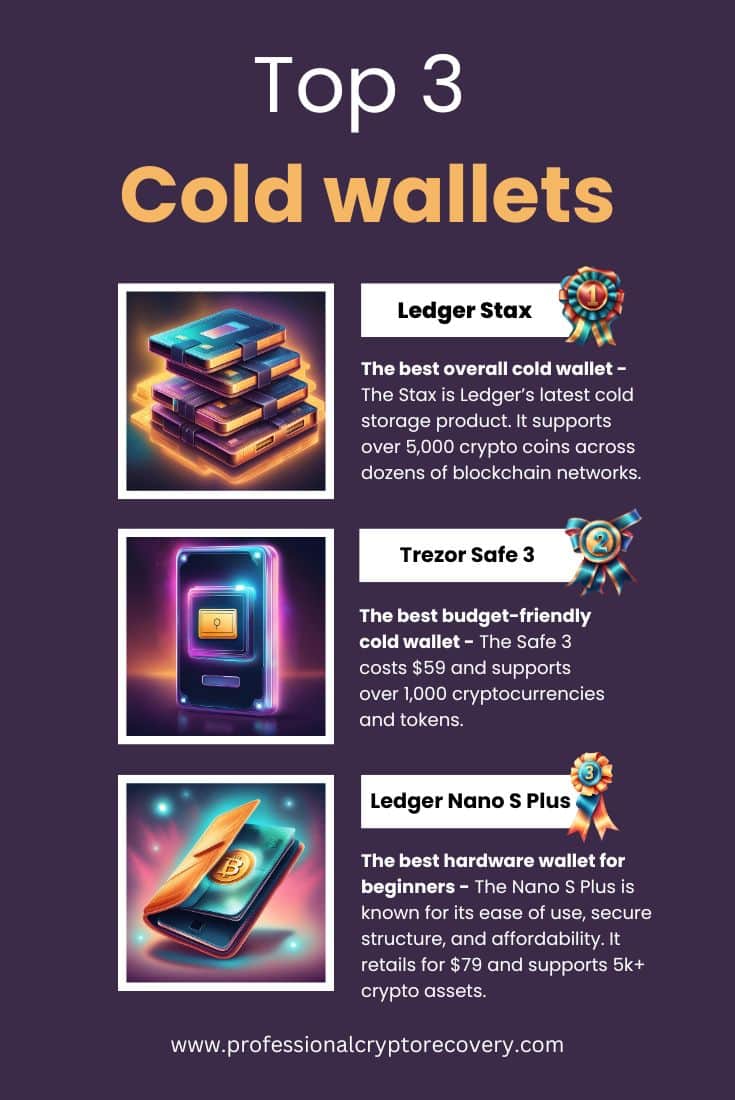
The best overall cold wallet comes from Ledger. Known as the Ledger Stax, this hardware wallet is Ledger’s most advanced cold storage product. It supports more than 5,000 crypto coins and tokens across dozens of blockchain networks. It can also be used to store non-fungible tokens (NFTs).
The Ledger Stax looks like a small, palm-sized touchscreen device. It has about the same thickness as a stack of five credit cards and uses the world’s first curved E Ink touchscreen for its display.
It can be customized with a lock screen photo or an NFT that stays on. The device can be connected to Windows, Android, macOS, and iOS devices via USB-C or Bluetooth. It also has wireless charging. Buying one will set you back $399.
2. The Best Budget-Friendly Cold Wallet
The best budget-friendly hardware wallet is the Trezor Safe 3. Going for only $59, the device supports more than 1,000 crypto coins and tokens. It has a small OLED display and two navigation buttons. The display, which can display up to 6 lines of text, shows all the details a user needs to verify a transaction.
The Trezor Safe 3 connects to computers and mobile devices via a USB-C cable. It has no wireless capabilities, meaning you will need an OTG adapter to use it with mobile devices.
If you have lost access to your Trezor wallet because of a damaged device, lost seed phrase, or forgotten passphrase, Trezor wallet recovery may be possible, depending on the circumstances.
3. The Best Cold Wallet for Beginners
The best hardware wallet for someone just getting started with cold storage is affordable, easy to use, and has a strong security reputation. There are many contenders for this, including the just-discussed Trezor Safe 3, but the Ledger Nano S Plus takes the spot.
Retailing for only $59, the Ledger Nano S Plus is an entry-level hardware wallet from one of the most reputable brands in the market. It supports 5000+ crypto assets, including NFTs, and has enough memory to have up to 100 apps installed simultaneously.
The wallet can be connected to macOS, Windows, and Android devices via USB-C. It has a navigation button and a small screen for displaying information needed to verify transactions.
Troubleshooting Cold Wallets
Some users eventually encounter issues that make it difficult or even impossible to use their hardware wallets. The most common scenarios involve physical/water damage to the device, losing the wallet’s seed phrase, or forgetting its passphrase.
In such situations, there is little the user can do except contact a wallet recovery expert. This is a cryptography and data recovery professional, like Professional Crypto Recovery, who specializes in helping people recover their crypto.
Professional Crypto Recovery has been in the IT industry for more than 21 years. We have a proven track record of success in helping people recover their cold wallets quickly, safely, and affordably. Contact us to get your recovery started now.
Frequently Asked Questions
Cold wallets are the most secure option for storing crypto assets. However, whether they’re the best option for you depends on your specific needs. Do you transact/trade often? Are you looking to interact with decentralized finance (DeFi) protocols regularly? In such cases, hot wallets are the better option.
To solve this dilemma, many crypto investors use both hot and cold wallets. Hot wallets are used to hold assets that are traded/transacted regularly, while cold wallets are used to securely hold assets long-term.
Cold wallets store their private keys offline to protect them from online hackers. However, that doesn’t mean they cannot be hacked through other means.
For example, if the device itself is stolen, then an unauthorized party can steal your assets. This is easily done if the thief manages to also steal your PIN. But even without the PIN, they could try a number of techniques to access your wallet.
No, not necessarily. Your hardware wallet doesn’t store your crypto assets; it stores your private keys while your assets remain on the blockchain. If you lose your hardware wallet, your assets are still on the blockchain.
Fortunately, there is a way to access them. If you still have your seed phrase, you can restore your wallet in a new hardware wallet or a supported hot wallet. Because it has the same private keys, this new wallet will let you access your crypto assets.