In 2025, federal agents received 10,516 complaints from victims of crypto recovery scams. These amounted to around $1.4 billion in losses during a year that saw scammers ramp up their impersonation of government officials and recovery firms.
Often, such schemes target victims of other scams who, in their desperation to reverse losses, can be easy to exploit. People who have lost access to their wallet through password or seed phrase issues also make an attractive target for recovery scammers.
So, how do you protect yourself from crypto recovery scams?
What Are Crypto Recovery Scams?
A crypto recovery scam is any fraud that targets someone who has lost access to their cryptocurrency. It’s a common scam because of the way self-custody wallets work.
In self-custody, crypto owners are given their private keys. This allows them full custody and control over their assets. It also burdens the user with the responsibility for backing up and recovering the wallet.
If you lose access to your assets, the wallet’s creators can’t help you get it back. It’s up to you to do it yourself.
But what if you can’t?
Some IT and data recovery experts have added crypto recovery to their services. This has helped many crypto owners recover funds they would otherwise have lost. On the flipside, it has created a new way for scammers to come after you.
These fraudsters pose as wallet recovery experts. Their goal is to get the victim to pay for a service that is never rendered or to give up information that gives the scammer access to the victim’s wallet.
Other scammers impersonate law enforcement. Usually, they target people who have already fallen for a scam, offering to use government resources to catch the scammers and reverse the transaction, for a fee.
How Crypto Recovery Scams Work
The typical crypto recovery scam looks like this:
- Someone loses crypto or access to their crypto.
- They post about it online looking for help.
- A scammer contacts them privately, promising to get the lost crypto back.
- Using fake credentials and manufactured proof (false testimonials, altered screenshots, fake website, etc.), they build credibility.
- They ask the victim to pay upfront for recovery, or depending on the situation, to hand over their private keys.
- They disappear with the victim’s crypto.
Another common tactic is to flood the comments of crypto-related social media posts with testimonials swearing by the recovery services of a certain individual (scammer). The goal here is to get anyone in need of recovery services to contact the scammer.
A more sinister approach is double targeting, which happens when a victim loses crypto to another type of scam, then the scammers come back after a few months, or sell the victim’s data to other scammers posing as recovery experts.
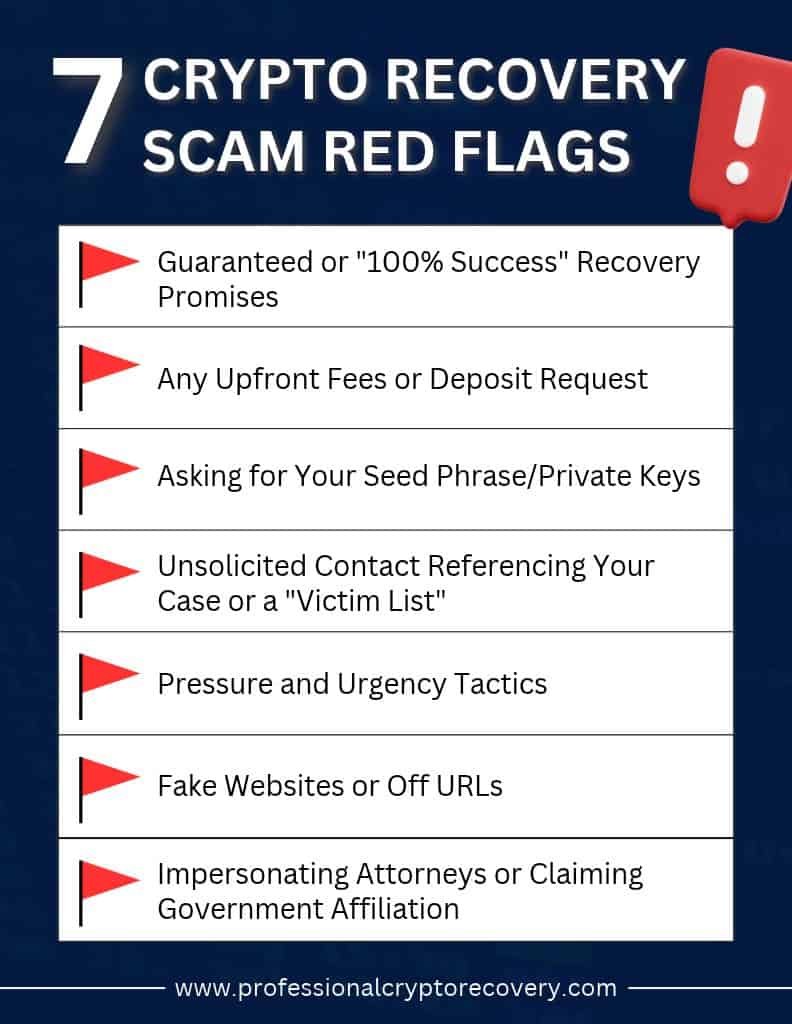
Crypto Recovery Scam Warnings and Red Flags You Should Watch For
So, how do you know if a crypto recovery business is a scam?
Guaranteed or “100% Success” Recovery Promises
To convince potential victims, scammers like to make grand promises, such as a 100% success rate. This should be an immediate red flag because crypto recovery is often a complicated process whose outcome cannot be ascertained beforehand.
Any Upfront Fees or Deposit Request
Because success is not guaranteed, it doesn’t make sense to ask for payment upfront. Anyone who wants a deposit or charges upfront fees should not be trusted. Among legitimate businesses, the norm is to take payment only after a successful recovery.
Asking for Your Seed Phrase or Private Keys
There are situations where a legitimate recovery company will ask for your seed phrase or private keys. But this is usually if there is an issue with them that is preventing you from accessing your crypto.
If someone asks you for this sensitive data upfront, with no apparent reason or agreed recovery process, they should not be trusted.
Unsolicited Contact Referencing Your Case or a “Victim List”
If you’ve lost crypto and someone unexpectedly contacts you claiming to know your situation and be able to help you, do not trust them. A legitimate crypto recovery expert will not contact you out of the blue.
Pressure and Urgency Tactics
Scammers like to use pressure and urgency tactics to force victims into a decision. Watch out for statements like ‘act today,’ ‘wallet will expire,’ ‘assets are moving,’ and ‘authorities need payment immediately.’
Fake Websites or Off URLs
Scammers may also use fake platforms to trick victims into giving up crucial data. To identify such a platform, watch out for typo domains, fake logos, cloned websites, and spoofed email addresses.
Impersonating Attorneys or Claiming Government Affiliation
Another common tactic scammers employ is impersonating government officials or legal experts. If anyone ‘from the government’ contacts you offering to help you recover a wallet you lost, you’re likely dealing with a scammer.
Scammers Exploit and Target Victims’ Vulnerability
Recovery scams are particularly effective because they exploit the victim’s desire to undo a loss. Usually, anyone who has lost their crypto, or access to it, is desperate to get it back. This creates a tendency to emotional decision-making that scammers are eager to exploit.
Are Most Crypto Recovery Services Scams? How to Vet a Legitimate One
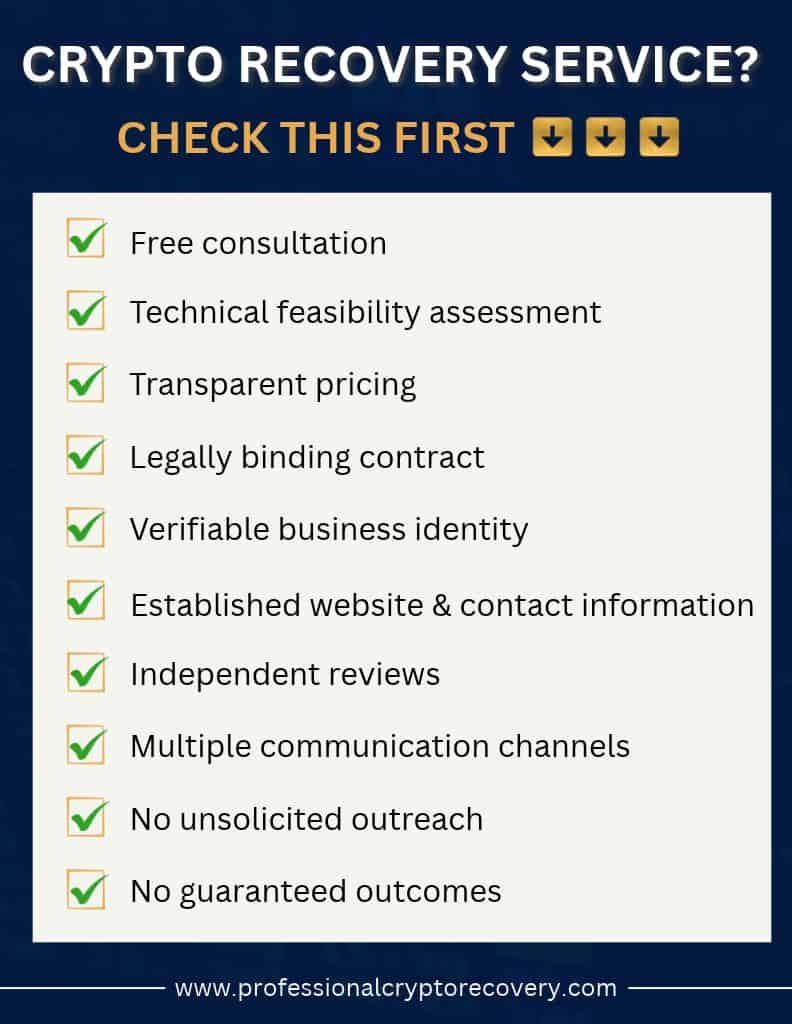
The crypto recovery sector has a scammer problem. Nonetheless, legitimate practices do exist, even though it is hard to estimate what proportion of services they constitute. Your best hope is to stress transparency and approach engagements with realistic expectations.
Here is a checklist to help you identify a legitimate service:
- Free consultation
- Technical feasibility assessment
- Realistic expectations
- Transparent pricing
- Legally binding contract before recovery
- Verifiable business identity
- Established website and contact information
- Independent reviews
- Open communication through multiple channels: phone, video, email, not just WhatsApp or Telegram
- No unsolicited outreach
- No guaranteed outcomes
- No requests for unnecessary wallet credentials
How to Protect Yourself From Recovery Scams
Overall, people lost a record $17 billion to crypto scams in 2025. Here’s how to protect yourself from becoming another statistic.
Never Pay Upfront
Payment before recovery is a telltale sign of a recovery scam. To be on the safe side, you should never pay upfront, even for a consultation. Cease communication the moment the other party asks for upfront payment.
Never Share Seed Phrases or Private Keys
Unless your specific problem is with the seed phrase and/or private key files (and only after the other party has outlined a clear recovery plan), do not share it with anyone. This is because this data automatically gives the holder full access to your wallet and crypto.
Ignore, Block, and Don’t Engage
If you receive unsolicited recovery offers in your inbox, do not engage. Ignore the message and block the sender. Note that sometimes, all the scammer needs to drain your wallet is to get you to click on a single phishing link.
Understand That Blockchain Transactions Are Generally Irreversible
Blockchain transactions cannot be reversed. If you have lost your crypto to a scam and watched it transacted out of your wallet, it is gone for good. Anyone who promises they can get your money back should not be trusted.
Need an Honest Assessment of Your Crypto Recovery Options?
Professional Crypto Recovery (PCR) is a crypto recovery business that specializes in helping people recover their lost crypto wallets. Our services range from hardware and software wallet recovery to recovery from discontinued platforms, old/damaged drives, and accidentally deleted data.
Our services are secure, transparent, and affordable. Before anything, we offer a free consultation session where we will assess your case to determine if recovery is feasible. If it is, we proceed with the utmost professionalism, taking care to protect your data and privacy. We only accept payment after a successful recovery.
Contact us to begin recovery.
Frequently Asked Questions
No. If a ‘recovery expert’ asks for a fee before completing recovery, they should not be trusted. Legitimate professionals tend to operate on a ‘no recovery, no fee’ basis. Anyone who tries to solicit payment before doing any work is likely a scammer.
Legitimate crypto recovery services typically charge a percentage of the amount in the wallet. At PCR, each successful recovery costs 18% of the wallet’s value. This makes us one of the most affordable recovery services in the market.
Generally, no. If you have your complete seed phrase, do not share it with anyone. However, if you’re unable to access your assets due to an incomplete recovery phrase, you might need to share it with a trusted professional for recovery. To be on the safe side, make sure you sign a contract before sharing any data.
Do not engage. If you’ve lost crypto and out of the blue someone reaches out offering recovery services, it is likely a scam.