Losing your seed phrase doesn’t automatically mean losing your funds. There are several other ways to regain access to a wallet, but each depends on what information, files, or devices you still have. This could include an exported private key, a wallet backup, a device that’s still logged in, or a working hardware wallet. Even deleted wallet files or data from an old hard drive may be recoverable. If you have any of these, there may still be a way to restore access. If nothing remains, recovery may not be possible.
Self-custody means you’re the one holding the keys. There’s no bank, no password reset link, and no support team standing behind your wallet. The seed phrase, that list of 12 or 24 words you were shown at setup, is how you restore your wallet if anything ever goes wrong.
So when it’s missing, its easy to start panicking. Without it, how do you get back in? It depends on what else you still have. This guide runs through each realistic option, which paths are worth trying, and which aren’t.
Your Crypto Wallet Recovery Options Without the Seed Phrase
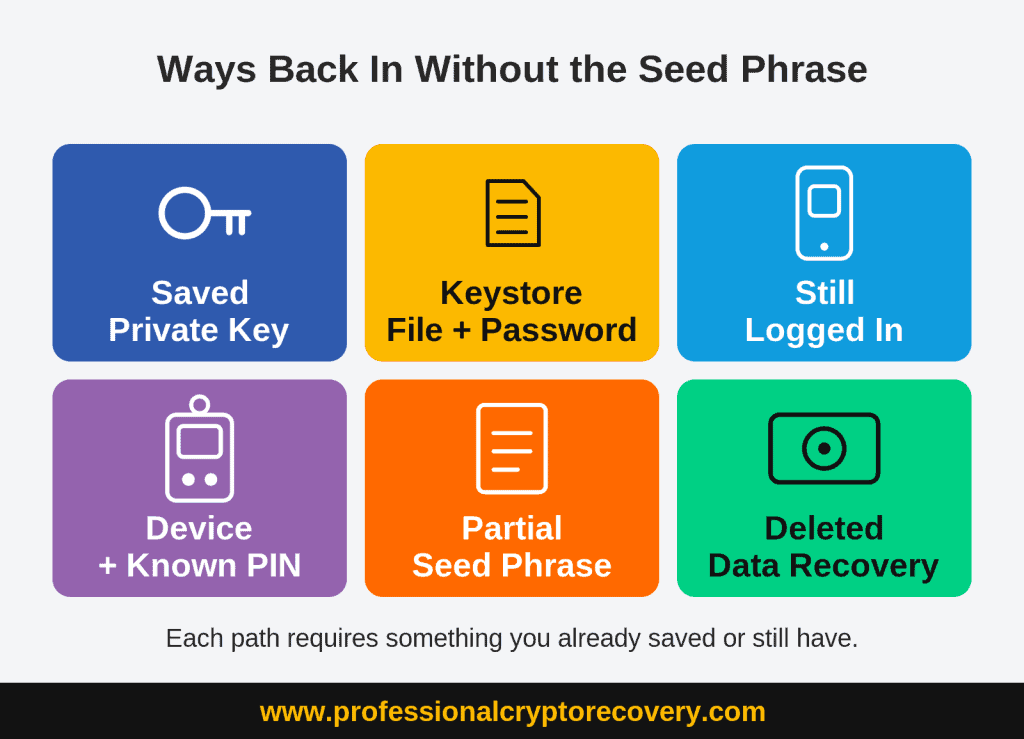
None of these are guaranteed. However, you should check each one to see if you have an alternative way to recover your wallet. Here’s what each one requires.
Using Your Private Key
A private key is different from a seed phrase. Your seed phrase generates the entire wallet, covering all your addresses and the keys behind them. A private key, on the other hand, only unlocks one specific address.
If you exported and saved a private key before losing access, you can import it directly into some wallets to recover the funds at that address. MetaMask, Exodus, and many other wallets support this. The thing to note is that your private key had to be saved beforehand.
Wallet-Specific Backup Files (Keystore/JSON Files)
Some wallets, especially older Ethereum wallets like MyEtherWallet and Geth, let you export a keystore file. This is a JSON file that contains your encrypted private key. It’s different from a seed phrase backup, and it only works if you also remember the password you used to create it.
If you have both the file and the password, you can usually restore the wallet without a seed phrase. Without the password, the file alone won’t get you anywhere. It’s encrypted, and there’s no shortcut around that.
If you no longer remember the password for your keystore file, or the password you have isn’t working, contact us. We specialize in recovering passwords for encrypted wallet files and may be able to help you regain access to your cryptocurrency.
An Old Phone, Computer, or Browser Extension That’s Still Unlocked
This is one people often overlook. If there’s an old device, a browser profile, or an unused laptop where the wallet extension was still logged in and never wiped, you may still be able to access it directly.
Beyond just opening the app, the encrypted vault file that browser wallets like MetaMask create can sometimes be extracted from an old browser profile, even if the extension itself won’t open normally. That vault still requires your wallet password to decrypt, but it’s another piece of the puzzle a professional service can work with. It’s really a case of recovering the seed phrase that was already stored on the device rather than bypassing it entirely.
Recovering Wallet Files From Deleted Data or Damaged Hard Drives
If your wallet was stored on an old computer, hard drive, or USB device, there may still be a way to recover it even if the files were deleted or the device no longer works properly.
Deleted files aren’t always permanently erased. Depending on the storage device and what happened afterward, it may be possible to recover wallet files or encrypted backups. As Microsoft explains in its file recovery documentation, deleted data can remain on a storage device until it’s overwritten.
Failing hard drives can also contain recoverable wallet information. Even if your computer won’t start or the drive is no longer accessible through normal methods, specialized data recovery techniques may be able to retrieve some of the original files.
If you suspect your wallet files were deleted or your hard drive is failing, stop using the device. Continuing to use it could overwrite deleted data or cause additional damage, making recovery more difficult.
Professional Crypto Recovery can help assess whether wallet data recovered from old or damaged storage devices can be used to restore access to your cryptocurrency. Recovery isn’t guaranteed, but losing the original files doesn’t always mean the data is gone for good.
A Working Hardware Wallet With a Known PIN
If you still have the physical device and know the PIN, you can access your funds directly without needing to re-enter the seed phrase. The seed phrase becomes critical if the device is lost, damaged, or factory reset. A working device with a known PIN still gives you access to your cryptocurrency.
If you’ve lost your seed phrase but can still access your hardware wallet, you should move your funds to a new wallet with a new seed phrase that you’ve securely backed up. Trezor also recommends transferring your funds as soon as possible if your wallet backup is lost. This ensures you can recover your funds if your current device stops working or is lost.
Don’t factory-reset your existing device until you’ve successfully transferred your funds to the new wallet. Resetting it wipes the keys stored on the device, and without the original seed phrase, you won’t be able to restore that wallet.
A Partial Seed Phrase
Having some of your seed phrase words narrows things down, but it doesn’t make recovery simple. Even a few missing words can mean millions of possible combinations to work through, and the difficulty scales fast as more words go missing. Success depends heavily on how many words you have and which positions they fill.
This is an area where a professional service can help. If you want to understand what’s involved when words are missing or incorrect, our guide on fixing an invalid seed phrase covers the mechanics in detail.
What You Can’t Use to Recover Your Wallet
Before spending time on approaches that won’t work, it’s worth being clear about two things a lot of people try.
A Public Wallet Address Alone
Your wallet address is essentially an account number. It’s public, visible to anyone on the blockchain, and it shows your balance and transaction history. But having the address, knowing it, or sharing it doesn’t grant access to the funds. Owning the address isn’t the same as owning the keys.
Transaction History Alone
Your transaction history can provide useful information during wallet recovery, such as identifying wallet addresses, tracing funds, or helping verify that the correct wallet has been restored. However, transaction history alone isn’t enough to regain access to your cryptocurrency. Blockchain records show where funds have moved, but you still need the appropriate private keys or other wallet credentials to access and transfer them.
When Crypto Recovery Is Generally Not Possible
If you have a non-custodial wallet with no seed phrase, no backup, no device, and no saved private key, there’s generally no path back in. That’s difficult if there’s real money involved, but it’s the honest situation.
The seed phrase is the root. Everything else, private keys, keystore files, wallet apps, hardware devices, derives from it or depends on it. Without any of those anchors, there’s nothing left to reconstruct from.
It’s also why backup habits matter so much. A paper or metal backup stored in a safe location is the kind of thing that feels unnecessary until it suddenly isn’t.
Avoiding Recovery Scams When You’ve Lost Your Seed Phrase
The emotional weight of losing access to crypto is exactly what recovery scammers count on. They know you’re stressed, that time feels urgent, and that you’re searching for any solution. They exploit all of it.
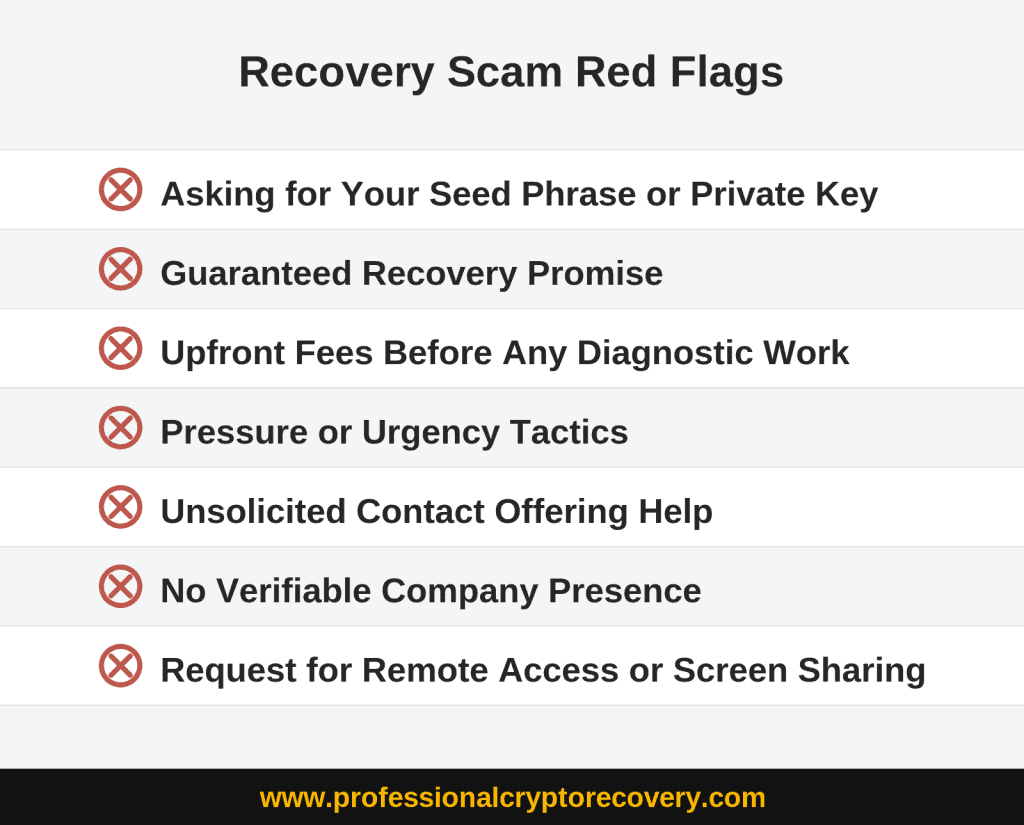
The crypto recovery space has more fraudulent operators than legitimate ones. Knowing the red flags before you contact anyone is your first line of defense. If you’d like a fuller breakdown of what separates a legitimate service from a scam, our guide on choosing the right recovery service covers it in detail.
Common Red Flags to Watch For
- Requests for your seed phrase or private key. A legitimate recovery service doesn’t need your seed phrase to start a conversation. Handing it over gives anyone immediate, full access to your wallet.
- Guaranteed recovery promises. No one can guarantee recovery, because outcomes depend on what data you still have. Anyone promising 100% success rates is lying.
- Upfront fees before any diagnostic work. Legitimate services look at the situation before charging anything. PCR works on a success-based fee, so there’s no upfront cost.
- Pressure and urgency tactics. Scammers may pressure you to act quickly, hoping you won’t take the time to verify their claims or research their services. A legitimate recovery provider should give you time to make an informed decision.
- Unsolicited contact. Be cautious of anyone who contacts you unexpectedly offering wallet recovery services. Legitimate recovery providers generally don’t reach out to people who haven’t requested their help.
- No verifiable company presence. No real website, no reviews on independent platforms, no traceable history? Walk away.
- Requests for remote access or screen sharing. Be cautious of anyone asking to remotely access your device or view your screen. This could expose sensitive wallet information, passwords, or private keys and potentially allow someone to steal your funds.
Need Help With Recovering Your Crypto Wallet?
Losing your seed phrase doesn’t necessarily mean your cryptocurrency is unrecoverable. It means the case needs a closer, more technical look than most people can manage on their own, especially when the situation involves corrupted wallet files, forgotten passwords, discontinued software, or damaged hardware where some data may still be recoverable.
PCR works with whatever you still have: partial seed phrases, vault files, keystore backups, old devices, wallet.dat files. If there’s a path, we’ll find it. If there isn’t, we’ll tell you that honestly, because an accurate assessment serves you better than false hope. You can read more about how the recovery process works before getting in touch.
We charge an 18% fee based on the amount recovered, with no upfront costs. You only pay if your recovery is successful. To get started, visit https://www.professionalcryptorecovery.com/get-started/ or call 1 (800) 645-1893.
Frequently Asked Questions
Possibly. It depends on what else you still have. A private key, a keystore file, an unlocked old device, or a partial seed phrase can each serve as a way back in. If none of those apply, recovery is difficult without professional help, and even then it isn’t guaranteed.
It’s worth getting an assessment. A legitimate service won’t charge you anything upfront. They’ll look at what you have and tell you honestly whether there’s a realistic path forward. That conversation costs nothing.
No. A public wallet address shows your balance and history on the blockchain, but it doesn’t grant access to the funds. You need a private key, seed phrase, or backup file to actually move anything.
Start by checking any device where you previously used your wallet, including old computers, phones, USB drives, and browser profiles. Even if the wallet application no longer works or its files were deleted, some wallet data may still be recoverable. Avoid resetting devices, formatting drives, or installing recovery software on the original storage device, as this could make recovery more difficult.
A legitimate service won’t ask for your seed phrase to start, won’t promise guaranteed results, and won’t charge you before successfully recovering your wallet. They’ll have a verifiable company presence, real reviews, and a transparent, success-based fee structure.