Cryptocurrency is a new financial frontier. But, unlike the centralized institutions of the traditional financial world, your success is in your own hands. When you participate in decentralized finance (DeFi), there is no customer service department to call when things go wrong.
Non-custodial wallets like MetaMask and Trezor are the best way to store cryptocurrencies. Unlike custodial wallets, they give you full control over your funds. You can withdraw your crypto whenever you want, and you’re not exposed to counterparty risk.
However, these benefits come with a huge task. It’s up to you, and only you, to guard your wallet’s seed phrase.
What is a seed phrase/crypto recovery phrase?
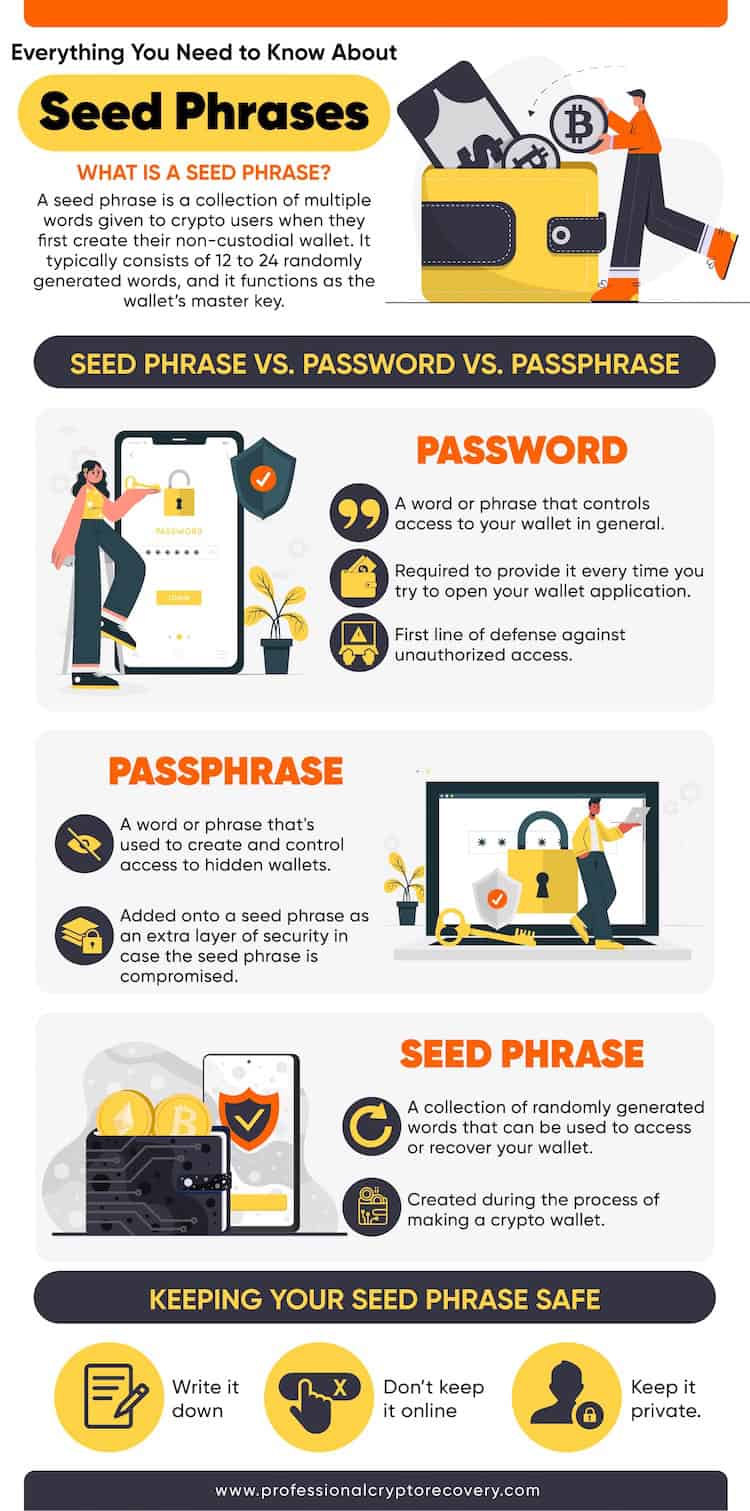
The seed phrase is a secret phrase given to crypto users when they first create their non-custodial wallet. It typically consists of 12 to 24 randomly generated words and functions as the wallet’s master key, giving you unlimited access to your wallet.
You can use the seed phrase to regain access to your crypto if an incident locks you out of your wallet. For example, your computer may get smashed, you may forget your password, or you might lose your hardware wallet. In any such event, the wallet’s seed phrase is all you need to regain access to your crypto.
Because it allows you to recover your wallet, some people refer to the seed phrase as a recovery phrase.
How the crypto recovery phrase works
First, let’s talk about how crypto wallets work. Your crypto wallet consists of two crucial parts: public and private keys.
A private key consists of a long string of alphanumeric characters generated when you create your wallet. It serves as proof of ownership of funds in the wallet, granting the owner complete control. They also function as the wallet’s digital signature and are used to sign off on crypto transactions.
On the flip side, a public key is your wallet’s unique address on the blockchain. The public address is a string of alphanumeric characters people use to send you crypto and is generated from the private key.
It’s important to note that your wallet doesn’t store crypto. All cryptocurrencies exist as data on the blockchain. Each bit is, in turn, associated with a particular wallet address. To display the amount of crypto you own, the wallet finds all the bits associated with your address and sums them up.
How does this tie to the recovery phrase?
Well, a wallet’s private keys are generated from its seed phrase. This takes place through a series of cryptographic steps. You can think of the seed phrase as a human-readable version of your private keys.
Rather than requiring you to memorize a complex string of characters, cryptographers thought to generate words instead, which are easier to remember than a combination of letters and numbers. The seed phrase is also known as a mnemonic phrase for that reason.
Thanks to this association, when you lose your wallet, you can use its seed phrase to recover it. By passing the words into the wallet software, you create a copy of them. It will have the same public and private keys. That way, you regain access to the crypto coins and tokens associated with your address.
Crypto recovery phrase vs password vs passphrase
The recovery phrase should not be confused with other secret words or phrases you use with your wallet, such as a password or passphrase.
Your wallet’s password is a word or phrase that controls access to your wallet. You’ll be required to provide it every time you try to open your wallet application. It is your first line of defense against unauthorized access.
The passphrase is a word or phrase that’s used to create and control access to hidden wallets. A hidden wallet is a unique wallet nested within the primary wallet. So, you use the password to open your main wallet and the passphrase to open the hidden wallet inside.
Another thing that sets the seed phrase apart is that, unlike the password and passphrase, you don’t set it yourself. Instead, the wallet creates it for you. Your responsibility is to write it down and keep it safe.
Types of seed phrases
Seed phrases can be classified according to their lengths or the technique used to generate them.
Length
A recovery phrase is usually 12 or 24 words long. The difference in length is a matter of security. The more words, the harder it will be to guess the seed phrase. So, a 24-word seed phrase is more resilient to brute force than a 12-word seed phrase.
However, that doesn’t mean that the latter option is weak. A 12-word seed phrase has a possible 2^132 combinations, making it nearly impossible to guess.
The Standard Used
In the past, wallets used different methods to generate seed phrases. The resulting phrases didn’t match on a technical level, making it difficult to switch between wallet brands.
Today, most wallets use the BIP39 standard. BIP39, or Bitcoin Improvement Proposal 39, is a standard introduced in 2013. It specifies a list of 2048 words that can be used to generate a human-readable representation of a wallet’s private keys.
That standard is used alongside other wallet standards, such as BIP32 and BIP44. BIP32 defines the rules for creating hierarchical deterministic (HD) wallets. HD wallets allow users to generate an unlimited number of public addresses and private keys from a single seed.
BIP44, on the other hand, sets the rules for creating HD wallets that support multiple cryptocurrencies.
Storing a seed phrase
Given the role your crypto recovery phrase plays, it’s absolutely crucial that it doesn’t get lost or fall into the wrong hands. If you go down the self-custody route, storing your seed phrase is your most important task. If you’ve already lost your recovery phrase, read our guide on how to recover your lost seed phrase.
To keep safe:
1. Write It Down
The seed phrase may only be visible once, and that’s when you first create the wallet. Write it down immediately (in the order in which it’s displayed) just to be sure. If you miss this window, you may still be able to see the recovery phrase after you’ve generated it, but it’s better to be safe than sorry.
2. Don’t Keep It Online
You should write your seed phrase on a piece of paper and keep the paper somewhere secure, like a safe. You should never store it on a Google Doc or anywhere online. If it’s online, it becomes a much easier target for hackers.
All hackers need to access the seed phrase on your Google Doc is your email password.
3. Don’t Share It
Don’t share your wallet’s mnemonic phrase with anyone. For 100% security, it should be a secret known only to you. If anyone ever contacts you pretending to be from your wallet’s manufacturer and asks you for your seed phrase, don’t give it to them.
How to use a seed phrase
Your wallet is the key to your crypto, and the seed phrase is the ultimate key to your wallet. If you ever lose your hardware wallet, forget your password, or damage your device, you can use the seed phrase to recover your wallet. Recovery involves launching the wallet software and feeding it the seed phrase in the exact order you received it.
The whole process should be straightforward. But if you need more information, here is a more detailed guide to recovering your crypto wallet.
Still having trouble? Look no further than Professional Crypto Recovery. We specialize in helping people regain access to their lost cryptocurrencies. Our fees are the lowest in the market, we have a fast response time, and we only accept payments if we succeed in recovering your assets.