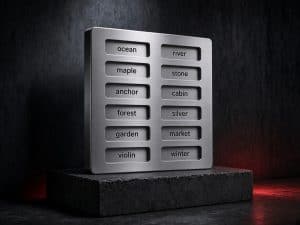
A seed phrase is the starting point for every address in your wallet, but it isn’t the only thing a wallet needs to find your coins. It also has to know where to look.
That’s why a restore can finish without a single error and still show a balance of zero. The phrase may be exactly right, and the wallet is simply reading a different set of addresses than the ones holding your funds. Wallets don’t all make the same choice about where to look, so the same words can open one wallet and look empty in another.
Here’s how a derivation path works, how to read one, which standards you’ll run into, and why it matters when a restore comes up empty.
What Is a Derivation Path in Crypto?
A derivation path is the set of directions a wallet follows to get from your master key to one specific private key and address. In plain terms, it tells the wallet which branch of the key tree to use.
Here’s the whole chain from the words you wrote down to an address you can share:
- Seed phrase: the 12 or 24 words from your backup.
- Seed: a long number the wallet calculates from those words.
- Master key: the top of the tree, which every other key comes from.
- Derivation path: the directions that pick one branch.
- Private key: the key at the end of that branch, which signs transactions.
- Public key and address: calculated from the private key. The address is the part you give people so they can send you coins.
Wallets built this way are called HD wallets, short for hierarchical deterministic. One seed grows a whole tree of keys, and the same seed always grows the same tree. That’s why you can restore a wallet from words alone, and the derivation path tells the wallet which branch to follow.
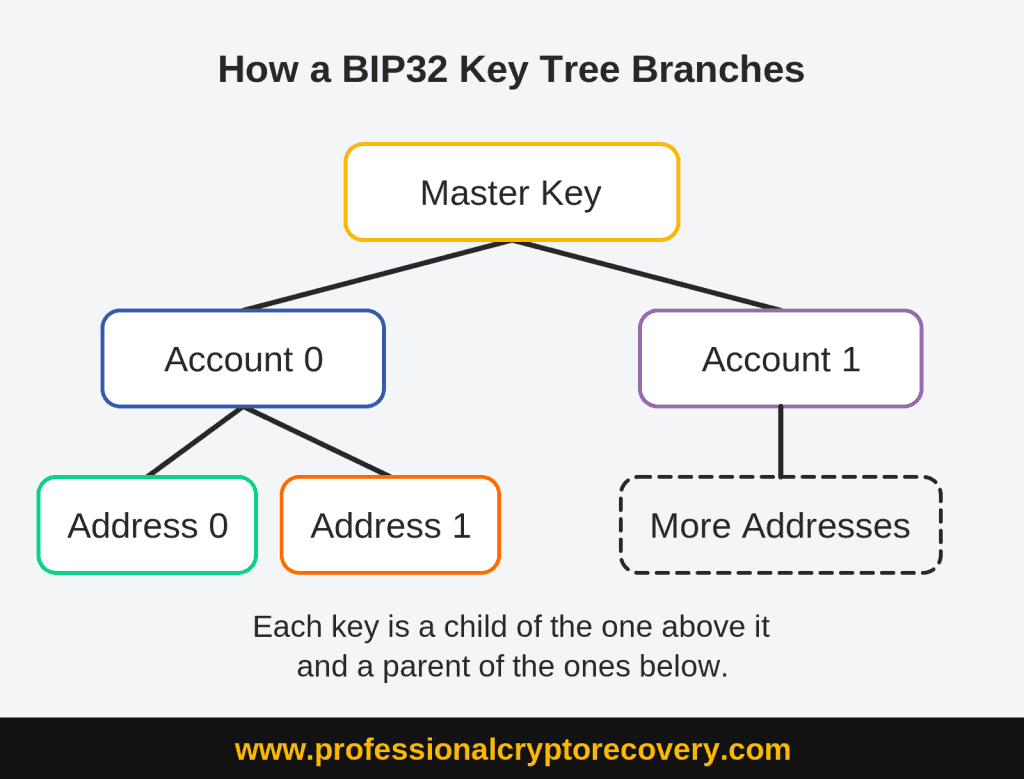
Parent and child are relative terms here. An account key is a child of the master key and a parent of its own address keys. Every child key is calculated from its parent, so a path is really just the list of steps down the tree.
BIP39 vs. BIP32 vs. BIP44: What Each One Does
Three standards cover the chain above, and each handles a different step. BIP39 turns your seed phrase into a seed. BIP32 builds the key tree from that seed. BIP44 sets the path format wallets use to pick a branch.
Not every wallet starts with BIP39, though. Electrum uses its own seed format, and a 20-word Trezor backup is SLIP39, so neither of those restores into an ordinary BIP39 wallet. Our guide to the BIP39 word list covers how a 12 or 24 word phrase is built and how to tell which kind you have.
How to Read a Crypto Derivation Path
Take the most common Ethereum path, m/44'/60'/0'/0/0. Each piece between the slashes is one step down the tree.
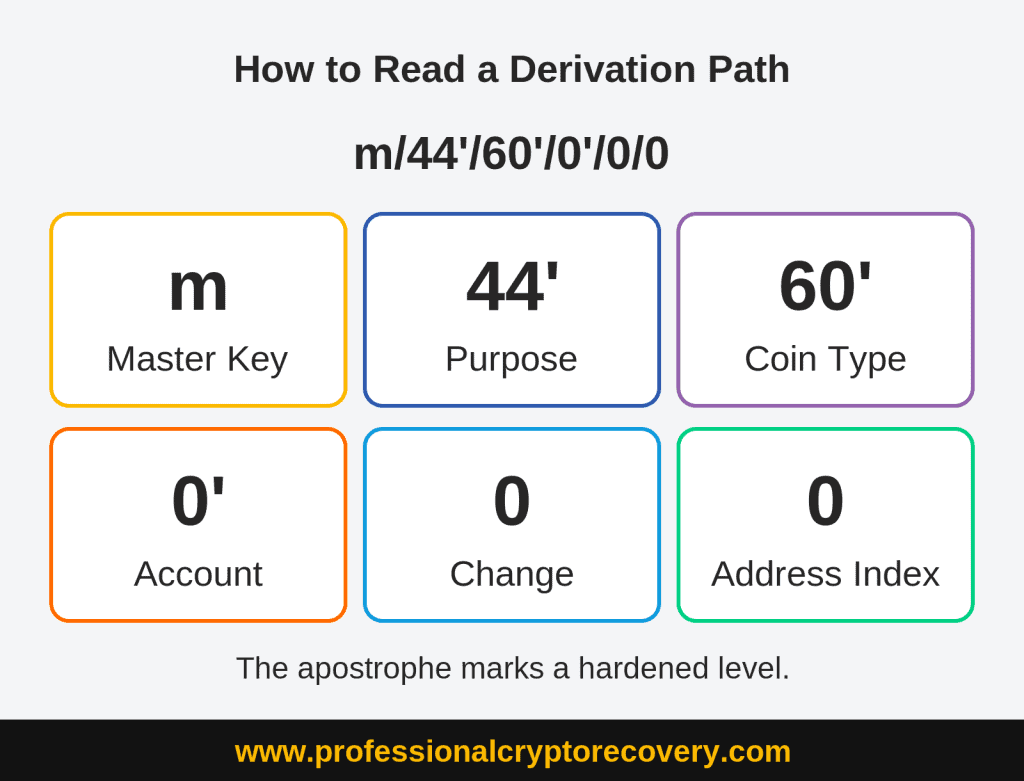
m: the master key, which comes from your seed phrase.44': the purpose. It signals that the wallet follows the BIP44 standard.60': the coin type.60is Ethereum’s registered number in the SLIP-44 registry. Bitcoin is0and Litecoin is2.0': the account. This is the first account, and a second one would be1'.0: the change level. A0means external addresses for receiving, and a1means internal addresses for change. The split matters for Bitcoin, and Ethereum wallets almost always use0.0: the address index. This is the first address, and the next ones are.../0/1and.../0/2.
MetaMask, Trust Wallet, and most Ethereum wallets default to m/44'/60'/0'/0/0, so the same seed gives the same first address in each of them. Most EVM chains, including Polygon, BNB Chain, and Arbitrum, reuse coin type 60. That means the same address works on all of them.
What the Apostrophe (Hardened Derivation) Means
The apostrophe marks a hardened derivation level, and some wallets write it as an h instead, as in 44h. Hardened derivation requires the parent’s extended private key (xprv), while non-hardened derivation allows child public keys to be generated from the parent’s extended public key (xpub).
In m/44'/60'/0'/0/0, the first three levels are hardened and the last two aren’t. Hardening the upper levels helps isolate accounts from one another, so a compromised private key within one account cannot be used to derive the private keys of other accounts.
The last two levels remain non-hardened for a practical reason. This allows a wallet to generate receiving addresses from an account’s extended public key without needing access to its private keys, which is how watch-only HD wallets work. Our guide to what an xPub is goes deeper on that.
Common Crypto Derivation Paths by Standard
Bitcoin kept adding new address types, first SegWit and then Taproot. Each one got its own path so a wallet knows which type to generate.
| Standard | Account Path | Address type | Prefix | Typical wallets |
|---|---|---|---|---|
| BIP44 | m/44'/0'/0' | Legacy (P2PKH) | 1 | Older HD wallets and legacy accounts in modern wallets |
| BIP49 | m/49'/0'/0' | Nested SegWit (P2SH-P2WPKH) | 3 | Early SegWit-compatible wallets and compatibility accounts in modern wallets |
| BIP84 | m/84'/0'/0' | Native SegWit (P2WPKH) | bc1q | Most modern Bitcoin wallets, including Sparrow and Trezor Suite |
| BIP86 | m/86'/0'/0' | Taproot (P2TR) | bc1p | Taproot-compatible wallets, including Sparrow and Trezor Suite |
Here’s what each one means in practice:
- BIP44 is the original multi-coin standard. It produces legacy Bitcoin addresses and is still the default for Ethereum.
- BIP49 is for nested SegWit addresses, a bridge format that lowered fees while staying compatible with older wallets. It’s less common today.
- BIP84 is for native SegWit addresses, a common default in modern Bitcoin wallets. It offers lower transaction fees than legacy and nested SegWit addresses.
- BIP86 is for Taproot addresses, the newest standard. Support is still growing, so it’s the one most likely to trip up an older wallet during recovery.
Your Address Prefix Tells You Which Standard Your Wallet Uses
You can look at any Bitcoin receiving address and make a good guess at which path your wallet uses:
- An address starting with 1 is legacy and commonly associated with BIP44.
- An address starting with 3 is P2SH, which may include BIP49.
- An address starting with bc1q is SegWit and commonly associated with BIP84 for single key wallets.
- An address starting with bc1p is Taproot and commonly associated with BIP86 for single key wallets.
Treat the prefix as a strong hint rather than proof. Addresses starting with 3 or a longer bc1q can also belong to a multisig wallet. Our guide to Bitcoin address formats shows what each type looks like.
These are Bitcoin prefixes only. Every Ethereum address starts with 0x, so the address itself tells you nothing about the path.
Why the Derivation Path Matters for Crypto Wallet Recovery
Most people searching for this topic are in the same spot. They restored a valid seed phrase and the wallet shows zero. A seed phrase restores the key tree, but the derivation path decides which branch the wallet reads.
If you aren’t sure that’s your situation, our guide on what to do when you lose access to your crypto wallet is the place to start.
It Tells Your Wallet Where Your Funds Are
A wrong path doesn’t break anything and it doesn’t move any coins. Your funds are still on the blockchain at the same addresses, and the wallet is checking different ones.
There’s also no error message. Every path produces perfectly valid addresses, so the wallet has no way of knowing it picked the wrong one. That’s why this scares people so much. A zero balance after a restore doesn’t mean the coins are gone.
If the wallet rejects your phrase as invalid, that’s a different problem. Our guide to fixing an invalid seed phrase covers wrong words and typos.
Your Seed Phrase Alone Isn’t Enough When Wallets Use Different Paths
The same seed can produce different addresses depending on the derivation path a wallet uses. MetaMask increases the address index, so its second account is m/44'/60'/0'/0/1. Ledger Live increases the account level, so its second account is m/44'/60'/1'/0/0. The first address matches in both wallets, but subsequent accounts follow different derivation paths and produce different addresses.
Some wallets also use nonstandard or legacy derivation paths. For example, older Ledger Ethereum wallets used m/44'/60'/0' as the base path and derived addresses directly beneath it, omitting the separate change level. Similarly, a Bitcoin wallet can use BIP44, BIP49, BIP84, or BIP86 with the same seed, each producing a different set of addresses.
These differences are why restoring a valid recovery phrase in another wallet doesn’t always display your original addresses or balances. The new wallet must use the same derivation path and address type as the original wallet to locate your funds.
Knowing Your Path Helps You Rule Out Other Causes
Once you’ve confirmed the path, two other things can still produce an empty wallet.
The first is a missing BIP39 passphrase, sometimes called the 25th word. It creates an entirely different wallet from the same seed phrase, and the wallet gives you no error. Our guide to a lost Ledger passphrase explains how that plays out.
The second is the gap limit. Wallets stop scanning after a run of unused addresses, and the standard limit is 20. If your funds sit further down than that, they can look missing even when the path is right.
Multisig and Custom Paths Can Complicate Wallet Recovery
If your wallet used a custom path or a multisig setup, trying the usual defaults won’t find the funds. You need the exact path on record, and for multisig you need the details of the setup too. Check the wallet’s own settings and any backup file or notes from when you created it.
Should You Write Down Your Crypto Derivation Path?
Yes, especially if you use anything other than a wallet’s default settings.
A seed phrase holds the keys, but it doesn’t tell a new wallet how to use them. It leaves out the derivation path and the address type, and it also leaves out any passphrase you added. If a new wallet guesses any of those wrong, you see an empty wallet and the panic that comes with it.
That’s the situation from the recovery section above, and a short note prevents it. Write down the wallet name, the path, the address type such as native SegWit, and whether you use a passphrase. The path and address type aren’t secret, so you can keep them next to your seed phrase.
Store the passphrase itself somewhere else, because its whole purpose is to protect the wallet if someone finds your words. Use paper or metal backups and store them in at least two secure, geographically separate locations to protect against fire, flooding, or other disasters. Our guide to metal seed phrase backups covers the main options.
When to Call a Professional
If you’ve tried the common paths and still see zero, the cause is probably something a path change can’t fix. A forgotten passphrase, a wrong word in the seed phrase, and a legacy wallet that no longer syncs are the usual ones. Professional Crypto Recovery handles these cases through our seed phrase recovery service. We never ask for a seed phrase or private keys on first contact.
Here’s how it works. You start with a free consultation, where we look at what you still have and tell you whether recovery looks possible. A legal contract comes before any work begins. The fee is 18% of recovered assets, charged only on success and taken from the recovered asset, with no upfront cost. You can read each step on our recovery process page.
The consultation is a look at what remains, not a promise of access. Book a free consultation or call 1 (800) 645-1893.
Frequently Asked Questions
No. The seed phrase is the starting point and the derivation path is the set of directions from it. Two wallets can use the same seed phrase and still show different addresses if they follow different paths.
Often you can. Check the wallet’s settings or its support pages, because most wallets document their default path. For Bitcoin, the first character of your receiving address narrows it down. Don’t type your seed phrase into a website or an online “path finder” to test paths. Use a wallet you downloaded from the vendor’s official site.
No. Changing the path only changes which addresses the wallet displays, and nothing is sent or moved. Your coins stay on the blockchain until you sign a transaction.
Paste your original receiving address into a block explorer. If it still shows a balance, the coins are where you left them. If it shows the coins being sent out, that’s a different situation, and no recovery service can reverse a confirmed transaction, PCR included.