Non-custodial wallets are a popular way to store your cryptocurrencies. Why? Because they let you retain full custody and control over your assets. They also provide a way to interact with decentralized applications (dApps) to participate in decentralized finance (DeFi).
All that is possible because the wallet’s creators don’t store your private keys for you. That duty is left to you, the wallet owner. You’re the one responsible for securing your private keys. The wallet also gives you a 12, 18, or 24-word phrase known as the seed phrase as part of this arrangement.
The popularized the term “private keys” as a common way to refer to seed phrases in the crypto community. But are these two really the same? Keep reading for the full breakdown.
What Is a Seed Phrase?
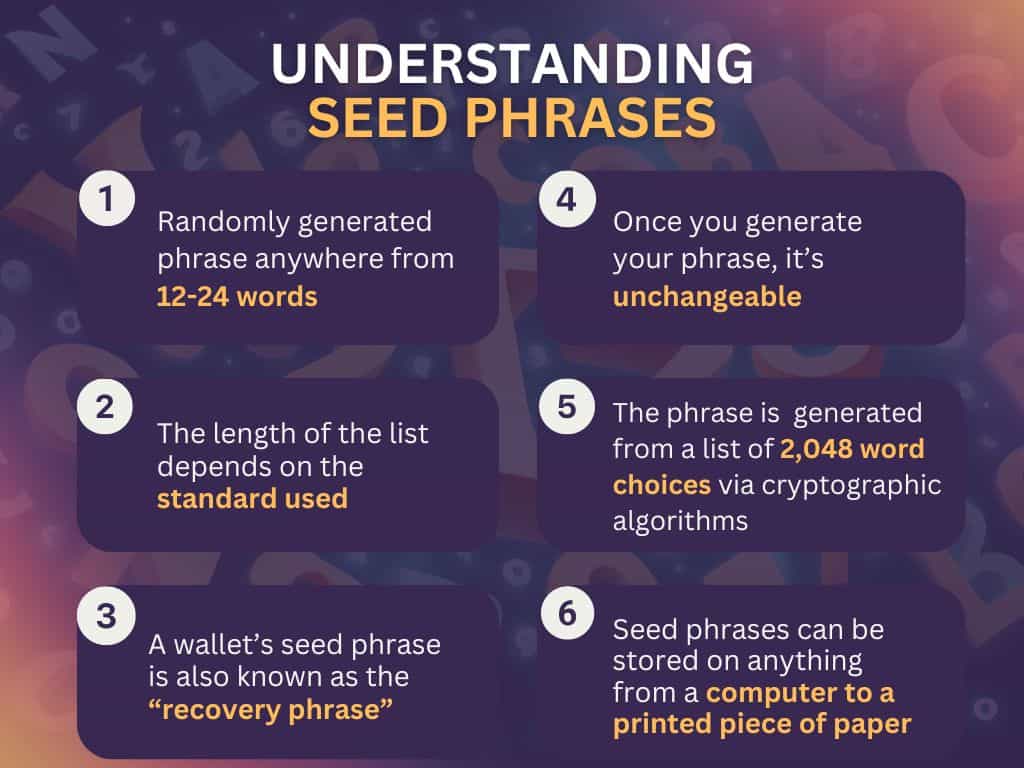
A seed phrase is a phrase made up of 12 to 24 words. These words are randomly generated from a list of more than 2,000 choices by cryptographic algorithms when you first set up your wallet.
Securing this phrase is the first and most important duty of anyone using a non-custodial wallet. You’re usually advised to secure it immediately by recording it on paper and safeguarding it at all times.
Wallets work via a combination of private and public keys, and the seed phrase is where it all starts.
Many wallets, including Metamask, Trust Wallet, Blockchain.com, Ledger, and Trezor, are hierarchically deterministic (HD) wallets. They use deterministic algorithms (those that produce identical outputs for the same inputs) to generate a sequence of keys from a single starting point.
Think of this single starting point as a master key from which all other keys are derived. And in this context, it is the seed phrase.
How a Seed Phrase Is Generated
During setup, a specialized algorithm randomly selects 12-24 words from a list. The length of this list depends on the standard being used. For example, BIP-39 (Bitcoin Improvement Proposal 39) is a common standard that specifies a list of 2,048 words.
Once a wallet application generates a seed phrase, its deterministic algorithms now use it to generate the entire structure of your wallet. This includes generating your public and private keys.
Multiple public-private key combos can be generated from the same seed phrase. Some applications, like Rabby Wallet, allow multiple wallets with different addresses and balances, all tied to the same seed phrase.
Seed Phrase as Recovery Phrase
A wallet’s seed phrase is also known as its recovery phrase. You can use it to create as many copies of your crypto wallet as you want. So, if you lose your wallet, you can always generate a new one to access your assets.
Seed phrase recovery is the process of restoring access to a wallet using this phrase. It works because the same seed phrase will always regenerate the same set of public and private keys when used with compatible wallet software.
How does that work?
The algorithms used by a wallet application to generate keys will always produce the same output for the same input. You can use your seed phrase to generate your wallet’s public and private keys across different applications and devices.
Why Use Words?
A prominent feature of the recovery phrase is that, in a world built on complex functions and algorithms, it is made up of words.
Why?
It’s a deliberate design decision to make recording (and even recalling for those who dare) the master key easier. Imagine if, instead of words, you were given a long string of numbers and symbols. That would make recording the root key for backup considerably riskier, as it’s easier to make mistakes and even harder to notice them. It would also make memorization impossible.
Words come more naturally to us. They’re much easier to record and remember than complex combinations of numbers and symbols.
What Is a Private Key?
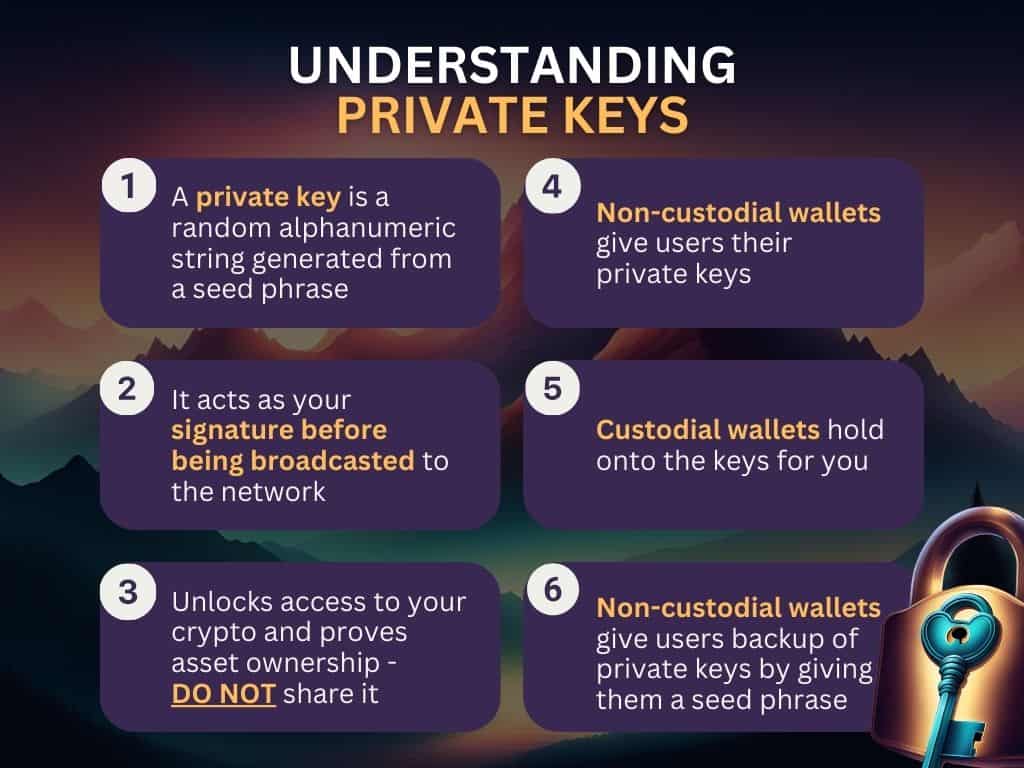
A private key is a long alphanumeric string derived from the seed phrase. It functions as a secret cryptographic key that proves ownership of the funds associated with a wallet’s particular public address.
Crypto transactions must be signed before they are broadcast to the network. That happens through the private key, which your wallet application uses to generate the required signatures to prove ownership and authorize transactions.
Think of your private key as the digital signature that unlocks access and proves asset ownership. Whoever has the wallet’s private keys controls the wallet.
They have unrestricted access to the assets associated with the corresponding public address.
It’s reason number one that private keys are meant to be private. You should never share your private keys with anyone, as you’ll be giving them full access to your crypto and the authority to transact.
Note that every crypto wallet has a private key. Wallets are categorized based on who gets custody of these keys:
- Non-custodial wallets: These give the user their private keys. When using such a wallet, you are responsible for securing it. Examples include popular software wallets such as MetaMask and Trust Wallet, and hardware wallets such as Ledger and Trezor.
- Custodial wallets: These hold onto the keys for you. You can still use the wallet to access and manage your assets. However, the wallet’s maker, usually an exchange, stores the private keys. Popular custodial wallets include Binance, Coinbase, and Crypto.com.
Many in the crypto space consider the first as the only way to truly own your assets. The phrase “not your keys, not your crypto” typically conveys this message.
How Wallets Give You Your Private Keys
As you might have figured out, non-custodial wallets provide a backup of your private keys via a seed phrase. It grants you complete control and access to your crypto on the blockchain. However, not all non-custodial wallets give you your private keys as a seed phrase. Take Bitcoin Core, for instance.
The core wallet allows users to run full Bitcoin nodes on top of managing their Bitcoin (BTC). It is fully decentralized and non-custodial. However, it doesn’t generate a seed phrase.
So, how does it give the user their private keys?
Bitcoin Core stores its private keys in a file known as “wallet.dat.” Users can access this file and back it up. They also have the option to encrypt it. Overall, being able to access and back up the wallet.dat file replaces the need for a seed phrase.
What is the Difference Between a Seed Phrase and a Private Key
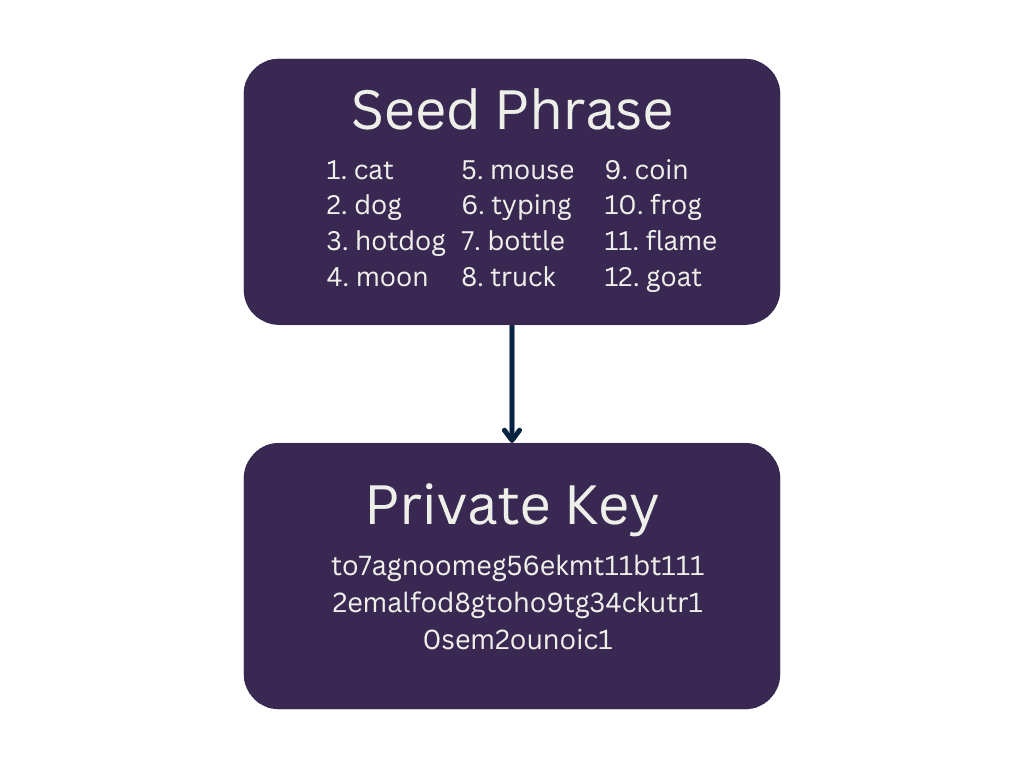
Some key differences between a recovery phrase and a private key are:
- A private key is a long alphanumeric(consisting of letters and numbers) string while a recovery phrase is a sequence of 12-24 words.
- In hierarchical deterministic wallets, the seed phrase is the first key to be generated. It is then used to generate public-private key pairs.
- Not all non-custodial wallets have a seed phrase. On the other hand, every crypto wallet has private keys.
- Private keys are used to prove ownership of a crypto wallet and sign transactions, while a seed phrase serves to back up a wallet’s public-private key pairs.
Your recovery phrase is not the same as your private keys. It does, however, contain your private keys along with the corresponding public keys. This allows you to use your seed phrase to recover your crypto wallet in case you are ever locked out.
If you own a non-custodial wallet, your recovery phrase is arguably your most important possession. It is the master key to your crypto world, allowing you to access and manage your assets on the blockchain whenever you want. So, it’s mandatory that you correctly record and securely store the phrase.
In wallets like Bitcoin Core, the wallet.dat file, which contains a wallet’s public and private keys, takes the place of a seed phrase. Bitcoin Core users are advised to make a copy of this file and store it securely, as it can be used to recover their wallet.
What Do I Do if I Have Issues With My Seed Phrase or Private Keys
Issues with seed phrases and wallet.dat backups are not uncommon. Thankfully, the only instances where the situation is unsalvageable are if you have completely lost your seed phrase or private keys.
If you still have the backup, you get an ‘invalid/seed phrase doesn’t exist’ error, or your wallet.dat file is partially damaged, you can fix the problem. You might need some help, though.
That’s Where Professional Crypto Recovery Comes In
Recovering a wallet’s seed phrase is a challenging task that demands a level of expertise most people lack. Fortunately, there are professionals dedicated to helping people recover their crypto wallets.
So, if you’re having issues with your wallet’s seed phrase or wallet.dat file, find a crypto recovery expert to help out.
Professional Crypto Recovery (PCR) is a leader in crypto recovery. Leveraging more than two decades of IT experience, we have helped hundreds of people regain control of their crypto assets through efficient, affordable recovery services. Get in touch now to kick-start your wallet recovery.
Frequently Asked Questions
No. Your seed phrase is not your private key. However, it contains your wallet’s private key and public keys. The feature allows you to create copies of your crypto wallet.
No. Because it can be used to generate a wallet’s keys, your seed phrase is like the master key to your crypto assets. Like private keys, you cannot share them with anyone.
Most seed phrases have 12 words. But depending on your application, it can extend to 18 or 24 words.
No. Wallet keys are generated by complex algorithms leveraging a very high level of randomness. This ensures that the resulting key is unpredictable and secure, making guessing impossible.